Seasonal stock control trends: Do you have your products ready?
At this time of year many businesses are dealing with seasonal demands and stock control. Seasonal trends come in many forms: increased sales of wine for the holidays, increased sales in HVAC systems during the northern hemisphere summer, or increased sales of ski gear in the southern hemisphere winter.
Regardless of the seasonal trend your business is dealing with, the key to success for a distribution business is to have the right product, in the right place, at the right time. In American terms, sending products from the Allentown warehouse to Philadelphia when your Pittsburgh branch is running low isn't going to increase sales.
Seasonal trends: Know what is likely to happen
Planning for seasonal trends consist mainly of three metrics:
1. How much did you sell in previous years during this season?
and:
2. How much have you sold year-on-year?
and a third in case of an unexpected circumstance.
3. How much did you sell in an outlier year when the weather was unseasonably favourable or not? or when a savvy new competitor landed.
These three metrics alone should give you an idea of what to expect. Perhaps, at a company level, your sales have increased. However, dig deeper and break these trends down by region and by branch. You might find that your branch in one region has seen a phenomenal increase in sales, while another has remained stable or even declined. There are measures you can take to remedy declining sales, but for now it may be wise to send more stock to your well-performing branch.
Other metrics you might consider are performance per product line or type, performance per sales rep, or even per marketing campaign.
Seasonal trends:Stay agile
While it is important to know what is likely to happen, it is perhaps just as important to be able to adjust to change. Factors outside of your control, such as a cold spell or heatwave, can impact your sales. This is both a challenge and an opportunity. It might be a challenge in that you do not have the quantities of products needed to meet demands. However, it is an opportunity in that your competitors did not plan for the unexpected event either. This means that, if your business can produce or purchase the right product fast enough, you may be able to win business from your competitors.
By staying on top of your business data you can spot these trends and act fast. Don’t wait until you’re out of product to realize you need to increase your order: see the trend emerging and order more before you run out.
Seasonal trends: Analyze your data in minutes
Does it take hours, if not days or weeks, to get seasonal sales insight across your business? With traditional reporting directly from ERP, CRM, and other data sources, that is often the case. These types of reports often require the IT teams to create the reports. Going back and forth with these teams to drill into your data is time-consuming for both parties, and often something that simply does not fit into a busy workday. On top of that, you might have to combine data from different sources and reports in spreadsheets. This again is time-consuming but also leaves room for error. A small error can easily be made in a spreadsheet, no matter how competent the person combining the data is. And needless to say, a misplaced comma or extra zero in a number or formula can have large impacts on how the data is interpreted.
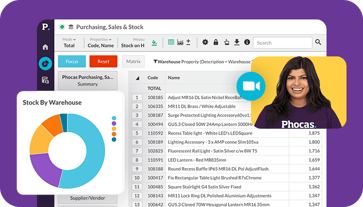
With data analytics solutions designed for inventory management , you can track metrics that are important to your business, and create reports in seconds or minutes. By logging on to your Phocas home screen, you can quickly get an idea of how you are tracking on your chosen metrics. Clicking through these visual representations will take you to a grid where you can query the data following your train of thought. You don’t have to wait for IT, you don’t have to combine data in a spreadsheet, and importantly; you cannot accidentally break or delete any data.


Empowering businesses with intuitive data analytics, driving informed decisions for growth and profitability. We make people feel good about data.
Related blog posts

Aktion Associates has been named FY26 North America Partner of the Year in the inaugural Phocas Partner Awards, following 90% year-over-year growth. A leading North American ERP and business technology partner to mid-market companies in architecture, engineering, construction, distribution and manufacturing, Aktion has worked with Phocas for six years to help customers see business performance more clearly and make more informed decisions.
Read more
Klipboard has been named the EMEA winner of the inaugural Phocas Partner Awards, recognizing the work its team has done to help distributors across EMEA become even more data-driven.
Read more
Kilimanjaro Consulting has been named the APAC winner of the inaugural Phocas Partner Awards. Kilimanjaro has grown customer value year-over-year, with 30% of existing customers extending their use of Phocas.
Read more
A recent Phocas survey found that half of the distribution respondents are testing general-purpose AI tools like ChatGPT and Claude on their own, outside of any business system. That's a reasonable thing to do but it is also where generic AI gets the numbers wrong for distributors in ways that are hard to know, because the answer looks exactly like a right one. It is important to know why a powerful generic AI tool can still be a wrong one and some of the important considerations of handing over your data to an AI engine.
Read moreBrowse by category
Find out how our platform gives you the visibility you need to get more done.
Get your demo today