Segmentation that protects your margins


One-size-fits-all replenishment is eroding margin
If you're replenishing your entire product range using the same reorder points, safety stock rules and lead times, you're almost certainly over-investing in slow movers while under-serving the accounts that actually drive your revenue.
Margin erosion you can't see
Discounting practices are rarely tracked against margin performance at the customer or SKU level — so margin leakage stays hidden until it's a big problem.
Drifting accounts go unnoticed
High-value customers quietly reduce purchase frequency before they churn. Without segmentation, you only notice when it's too late to re-engage them.
Reps fly blind
Only 31% of distributors trust their own inventory data.* When the numbers are unreliable, reps default to gut feel — and every account looks equally important.
Disconnected teams, misaligned strategy
Sales, purchasing and finance all working from different data can't agree on which customers to protect and which product lines to prioritise.
Customer quote
Smarter segmentation starts with behavioral data
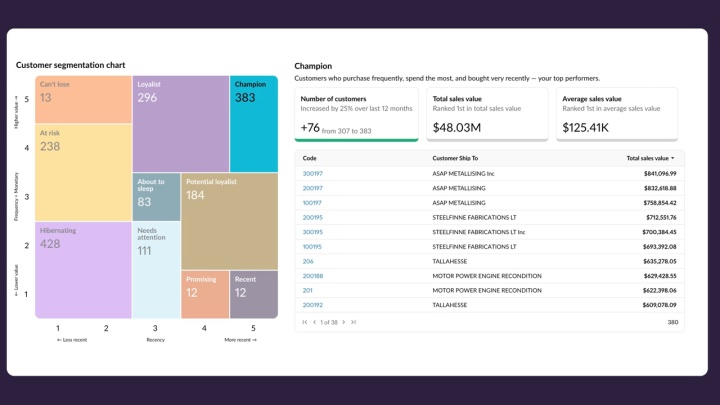
The most effective method is RFM analysis — a model first developed by Jan Roelf and Tom Wansbeek in the 1990s and now widely adopted across wholesale distribution. Rather than grouping customers by geography or industry, RFM segments them by how they actually buy.
Recency
How recently did this customer last purchase? A high recency score indicates active engagement — and lower churn risk. A customer who hasn't bought in six months needs immediate attention.
Frequency
How often do they buy? High frequency signals brand loyalty and a dependency on your range. Low frequency from a high-spend account may indicate they're also buying from competitors.
Monetary Value
How much do they spend overall? Monetary value reveals your true top accounts — which may not be the same as your loudest or most demanding ones. High value + low frequency = opportunity.
How Phocas supports segmentation
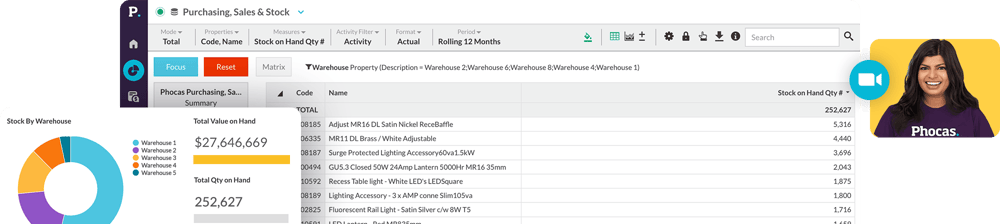
Phocas connects to your existing ERP and brings customer, product and inventory data together in one view. So, your sales, purchasing and finance teams are all looking at the same data.
- Segment customer automatically: Phocas Insights uses RFM analysis to instantly group your accounts by value, purchase frequency and growth trajectory.
- Spot drifting accounts early: see which customers are buying less frequently or spending less – act before they move to a competitor
- Track discounting: review discount trends against margin performance across customers and SKUs
- Monitor pricing consistency: see where pricing varies across branches, reps or customer segments and flag anomalies
- Give reps instant clarity: Empower sales reps to see high-value accounts, at-risk customers and where to focus – the moment they log in
Customer quote
"We are constantly watching for changes in trends related to specific products and take action to adjust inventory up and down accordingly.”
Why segmentation matter to distributors
plan to introduce more product and customer segmentation in the next two years
report losing sales from not having the right stock – segmentation directly addresses this
say data-driven inventory management is their #1 operational priority for 2026
Everything connects, everyone benefits
Phocas integrates with your existing ERP to bring sales, inventory, financial and customer data into one place. Each product builds on that foundation — so segmentation insight flows across your whole business, not just one team.
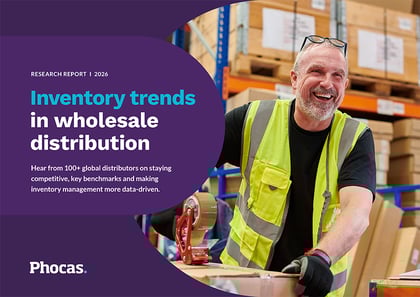
Inventory trends in wholesale distribution
If products and supply chains are part of your working day – this new trends report is a must read.
Frequently asked questions
Demand planning software forecasts demand for all of your products based on consolidated data, seasonality, promotions and customer behaviour. The primary goal of demand planning software is to help businesses optimize inventory levels, streamline production schedules, and ensure sufficient stock availability to meet customer needs while minimizing excess inventory and tying up cashflow.
When selecting demand planning software it is essential to consider how the platform can access and store data. The more detail you can forecast to like by sales value, sales cost, stock availability and number of invoices the better the accuracy. Ensure the software can accept supply chain management information from the warehouse and beyond as well as pertinent information from your ERP as well as be able to customize the databases to support your business nuances.
Effective demand planning often requires input from multiple stakeholders across different departments. Look for software that facilitates collaboration by enabling teams to share data, insights, and feedback in real-time.
The software should provide powerful analytics and reporting capabilities to track forecast accuracy, monitor key performance indicators (KPIs),and identify trends and patterns in demand data. Look for customizable dashboards and real-time insights to support data-driven decision-making.
Demand planning and demand forecasting are closely related concepts in business operations and supply chain management, but they serve different purposes and involve distinct processes.
Demand forecasting involves predicting future customer demand for a product or service based on historical data, market trends, seasonality, and current conditions. Demand planning involves translating demand forecasts into plans and strategies to ensure that the right products are available in the right quantities at the right time.
Yes, many software solutions are designed to handle both inventory management and demand forecasting within a single integrated platform. These types of software offer features to help businesses optimize their inventory levels while accurately predicting future demand. Look out for platforms that offer Artificial Intelligence capability, multiple system and data integration plus reporting and analytics.
The Phocas platform integrates data from various sources, including historical sales data, inventory levels, customer orders and market trends to facilitate both inventory management and demand forecasting processes. Phocas includes advanced forecasting algorithms and models to generate accurate demand forecasts. Planners can adjust parameters and perform scenario analysis to improve forecast accuracy.
Understand the past, operate better today, and plan well for the future