Economic uncertainty drives a new calculus for distributors and demand planning

While fundamentals such as demand and lead time remain constant, the swift disruption of today’s external market conditions have required wholesale distributors to have a flexible approach to inventory management.
A tactical way to optimize cash flow, enhance supplier relationships and steer sustainable growth, inventory management is now a core strategic lever across the industry, according to the first annual Inventory Trends in Wholesale Distribution Report, released by business financial planning and analysis platform Phocas. Its research highlighted key inventory trends in wholesale distribution for 2026.
Distributors across all segments of industry are reacting to greater competition and economic volatility by holding more stock, largely driven by the need to retain customers. This trend shows a re-evaluation of traditional inventory management systems.
“Inventory management can be siloed in a distribution company,” said Phocas CEO and Co-Founder Myles Glashier. “To do it well, the purchasing team needs to work closely with sales and finance so they can move with the market.”
When asked what capabilities they want to enhance or add this year, wholesalers advised demand planning and more data and warehouse automation, alongside customer and product segmentation. These adjustments mirror the increasing complexity of the wholesale sector and requirement for data-driven decision-making.
“Demand planning is a core need for distributors, yet the industry faces an accuracy gap due to limited access to the right data. Distributors that can keep planning up to date with current sales are lowering the cost of inventory and improving service levels,” Glashier stated.
He told MOTOR that the top priority for automotive afterpart distributors is to focus on efficiency to manage economic uncertainty. The industry is analyzing inventory insights to find incremental improvements across operations, and examples cited include adjusting automatic reordering, improving planning parameters and redirecting spend toward fast-moving, shortage-risk items.
MOTOR recently spoke with Royal Coburn, CEO of the automotive aftermarket’s Competition Specialties, Inc., now in its 60th year, on how his company is responding to those trends.
The company is the largest wholesale distributor in the western U.S., specializing in common high-performance parts and off-road accessories for cars, trucks, and SUVs. It also has its own private label. Its two-step distribution model features three warehouses offering 186 product lines with a fill rate of over 94 percent for its brick-and-mortar and retail customers, who are local shop owners and dealership parts managers.
The following is MOTOR’s conversation with Coburn on a few of those trends and key takeaways. His comments have been edited for length and clarity.
How are competitive pressures driving how you continue to differentiate?
Some of our biggest pressures are national distributors that have continually consolidated and acquired other regional distributors. And so that gives them, of course, bigger buying power and more robust logistics services to compete against. So that’s been our biggest challenge. But when all things are equal—pricing and product transit time—they’re going to always pick relationships.
That’s what I try to impart to my team: make sure you’re in a good, positive relationship because that’s who people want to buy from, not who they have to buy from. But to be clear, all things have to be equal before you win that kind of motivating factor. If you’re priced too high, or the product takes too long to get there, they’re going to always pick the national distributor.
We also live in the Amazon world now. So if it’s the fastest and the cheapest, they’re going to buy. But, again, if all things are equal, you would probably run out and support brick and mortar at your local retail storefront on the same products you got from Amazon, assuming it was just as convenient. But Amazon’s gotten pretty big, super convenient and super cheap.
So, for distribution on the automotive side of things, we have to really make sure we’re offering the best service and the best relationships that we can.
How are your inventory strategies and demand planning helping you adapt to economic uncertainty?
With today’s economic uncertainty, we just don’t know, right? With the fuel prices where they’re at—and a [U.S.-Iran] deal that’s off and on again—just the idea of a war kind of puts people in a weird pause-buying mindset.
We want to make sure that we’re doing strategic buys any chance we can. So when we see a pending price increase, we’re purchasing with a four-month forecast rather than a 60-day forecast because we want to lock in those certainties and our costs. There’s a chance that maybe some fuel surcharges or importation fees can have impacts. You try to be nimble.
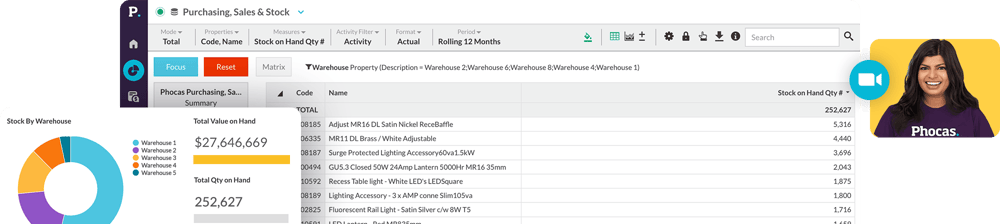
During tariffs, we definitely shifted to brands that we could source locally. We use tools provided by Phocas to quickly understand what that margin variance is and to see where we should be pivoting from one brand of the next.
If we’re getting too many price increases with one and we’re having to maintain our sale price to keep competitive, and we see some margin progression, that’s when we know we need to shift.
We didn’t use Phocas here when I arrived, and so much has changed since then. Those tools have been a light bulb moment for so many of our top ops and management teams, who didn’t really understand some of the true costs and landed margin of a lot of products and overall strategies. So it’s helped our profitability out a ton.
There are also territorial concerns when it comes to suppliers. Luckily, Competition Specialties is big enough where manufacturers would love to get a phone call to say we’re interested in their product. We try to leverage what we can within that same category, same product. But sometimes with our customers, it’s not just the question of us pivoting, but also, “Are they willing to pivot with us?”
If I’m doing a four-month buy on products to try to leverage an extra 5 or 10 points on the acquisition, we’re going to push sales that way with everything we can. But that only goes so far, because we’re not talking to the end consumer. We’re only talking to the brick-and-mortar retailer. It’s how much they can see. So we usually pass along our savings to them. They see the added value.
We use that demand planning to build out those forward buys. What are the trends for specific vehicles rather than having a shorter telescope for only 60 days out? We’re trying to expand that a little bit and try to multiply our demand to cover a four-month path rather than stubbing our toes with inventory that doesn’t move.
This article is reproduced from MOTOR magazine and is written by Rob Merwin, MOTOR Editorial Advisor.
Get in touch with the Phocas communications team by emailing your enquiry below.
Email usMedia center

Understand the past, operate better today, and plan well for the future