The cost of business intelligence and other myths
Even though the business world is abuzz with business intelligence tools and the internet is filled with endless information about data and the results it can deliver, there are many organizations that don’t use BI. Perhaps it’s because people believe their current system works fine, or they think the cost of business intelligence is prohibitive, or maybe it’s about the complexity they think is involved in implementation. Whatever your reason, we challenge you to consider BI in different ways.
We address these four myths in this blog to assist business leaders to understand BI and the value it brings.
Myth 1: “BI is too complicated”
Business intelligence is defined as a “a set of methodologies, processes, architecture and technologies that transform data into meaningful and useful information to enable more effective strategic, tactical and operational insights into decision-making”.That does sound complicated, but it's not, because all the technical work is done for you. BI software is a framework that gives you all the data you need to make better decisions in an organisation.
BI does come with underlying mechanisms for rather complex analytics, but the multitude of BI tools on the market have teams of software developers continuously working to make the UX simple and user friendly. Phocas' philosophy is to make people feel good about data so our software is built with an intuitive interface, to ensure it is easy to use by non-technical business users and to enable fast and accurate decisions.
And yes, implementing BI will involve several steps, and several people in your organisation, but Phocas has a six step process which is tried and tested. After the implementation, you'll receive training from your designated customer success consultant so everyone feels confident using the software.
The clarity in your data, the ability to draw insights and the ability to make strategic, tactical and operational decisions confidently ultimately be enough to outweigh the complexities.
Myth 2: “BI is too expensive”
Implementing a BI tool needs to considered as an investment with a return. If you decide to build an in-house BI tool, you need to prepared to write a bigger amount on that cheque and it will take longer to achieve an ROI . But if you are considering a tool that is already in market with built-in features and dashboards, it is much more cost effective. And with the BI experts building tools and delivering them through cloud platforms that allow you to pay a monthly fee and avoid all the costs to maintain and upgrade, why wouldn’t you use it?
The investment is completely justified as you build a BI strategy and implement the right tool, you will have the ability to see reports made out of multiple sources of data that previously were unstructured, draw insights from the data to develop forecasts and determine the right actions to take. The ability to make better decisions that enable your business to thrive in constantly changing conditions is definitely worth the investment as is the reduction of waste, knowledge of poor performing product lines and full visibility across a business.
Myth 3: “We’ve got Excel, that’s enough”
No that’s not enough! A few blog articles ago, we discussed how using Excel for your business intelligence is a big sign that your company needs a BI tool. A spreadsheet doesn’t provide intelligence, it provides historical data. In addition to that, spreadsheet-based BI is a highly manual process that is prone to errors, and due to the time it takes to prepare, often delivers outdated and inaccurate data.
Specifically with Excel, complexities may be rampant since data may require different macros and the process of developing, updating and maintaining those macros require specific technical skills and is very time consuming. It’s also common for spreadsheets to be accessed and updated by multiple people, and saved in different locations. What businesses end up with is a few different versions of the spreadsheet that will take time to analyse, and reports that are much less reliable.
A real BI tool can process through multiple sources of real-time data and consolidate them to provide a single version of reports to help you draw the most accurate and up to date insights. It’s also capable of allowing each business user to customise their filters or dashboards to view the data they need in the manner they prefer.
Myth 4: “I've got a BI tool, I’m all set”
The ability to make better business decisions does not come to you just because you implemented a BI tool. For insights and decisions to be accurate, you need accurate data! The quest for better insights and better decision-making doesn’t stop at the implementation of the right tool. You need to emphasise:
- High-quality data
- Clear definitions of metrics to track
- Ongoing support
- Collaboration
It is important to set policies to ensure people know the quality of data that is required and that they adhere by these policies. Regular training sessions might come in handy to ensure people consistently stick to the guidelines for high-quality intelligence.


Empowering businesses with intuitive data analytics, driving informed decisions for growth and profitability. We make people feel good about data.
Related blog posts

Aktion Associates has been named FY26 North America Partner of the Year in the inaugural Phocas Partner Awards, following 90% year-over-year growth. A leading North American ERP and business technology partner to mid-market companies in architecture, engineering, construction, distribution and manufacturing, Aktion has worked with Phocas for six years to help customers see business performance more clearly and make more informed decisions.
Read more
Epicor has been named the winner of the inaugural Phocas Partner Awards in the global category, marking 18-years of partnership. Epicor leads the way among Phocas' global partners in delivering customer value and success.
Read more
If you've been paying attention to the data analytics space lately, you've probably noticed a new term emerging into conversations that used to be dominated by business intelligence (BI) and that’s decision intelligence (DI).
Read more
A purchasing manager at a wholesale distribution company makes hundreds of decisions every week which involves many different data sets and departments. Reorder this SKU or wait? Approve this customer's credit extension? Switch suppliers on this product line? Adjust pricing on a slow-moving category? And now with the rise of machine learning many of these decisions will be automated.
Read moreBrowse by category
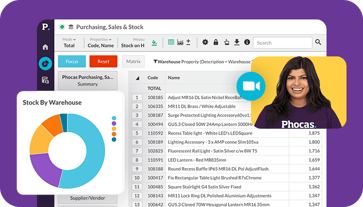
Find out how our platform gives you the visibility you need to get more done.
Get your demo today