How can you maximize the business benefits from your enterprise resource planning (ERP) system? You get there by rethinking ERP reporting as a layered reporting system that turns ERP data into real-time insights, not just historical outputs. For years, enterprise resource planning platforms have been the backbone of manufacturing, distribution and retail because they capture orders, inventory, invoices and financial data in one place. Yet the price and effort of implementing ERP software has often led business people to question whether the company is getting the value they expected. It depends on how well people can access, analyze and act on the information inside the ERP system and related data sources.
Where ERP reporting began
Early ERP reporting was designed for control and consistency. Whether you used SAP, Netsuite, Microsoft Dynamics or another ERP software, the built-in reporting tools typically focused on financial reporting and compliance. Finance teams relied on balance sheets, general ledger summaries and fixed templates that were printed monthly or exported into Excel formats. This approach created dependable numbers, but it also created a slow reporting process. If a CFO needed ad hoc answers or custom reports, those requests often went to IT or a small group of experts, who had to extract datasets from the ERP system, clean complex data, and stitch it into spreadsheets. This approach delayed resolving issues or worse, issues began to fester.
The limitations were not just about speed. Traditional ERP reporting tools were narrow in scope because they lived entirely inside the ERP system. Valuable datasets in a CRM, an inventory management platform, or eCommerce tools could not easily be included, so leaders made decision-making calls based on partial views. The reporting system became a place to look backward rather than a way to optimize the future.
Why ERP reporting evolved
As supply chains accelerated, margins tightened and competition grew sharper, businesses needed real-time data and real-time reporting to spot risks and opportunities early. At the same time, data sources multiplied. Sales teams wanted CRM and customer activity, operations needed supply chain and inventory management visibility, pricing teams wanted profitability by product and customer, and finance needed cash flow clarity linked to current business activity.
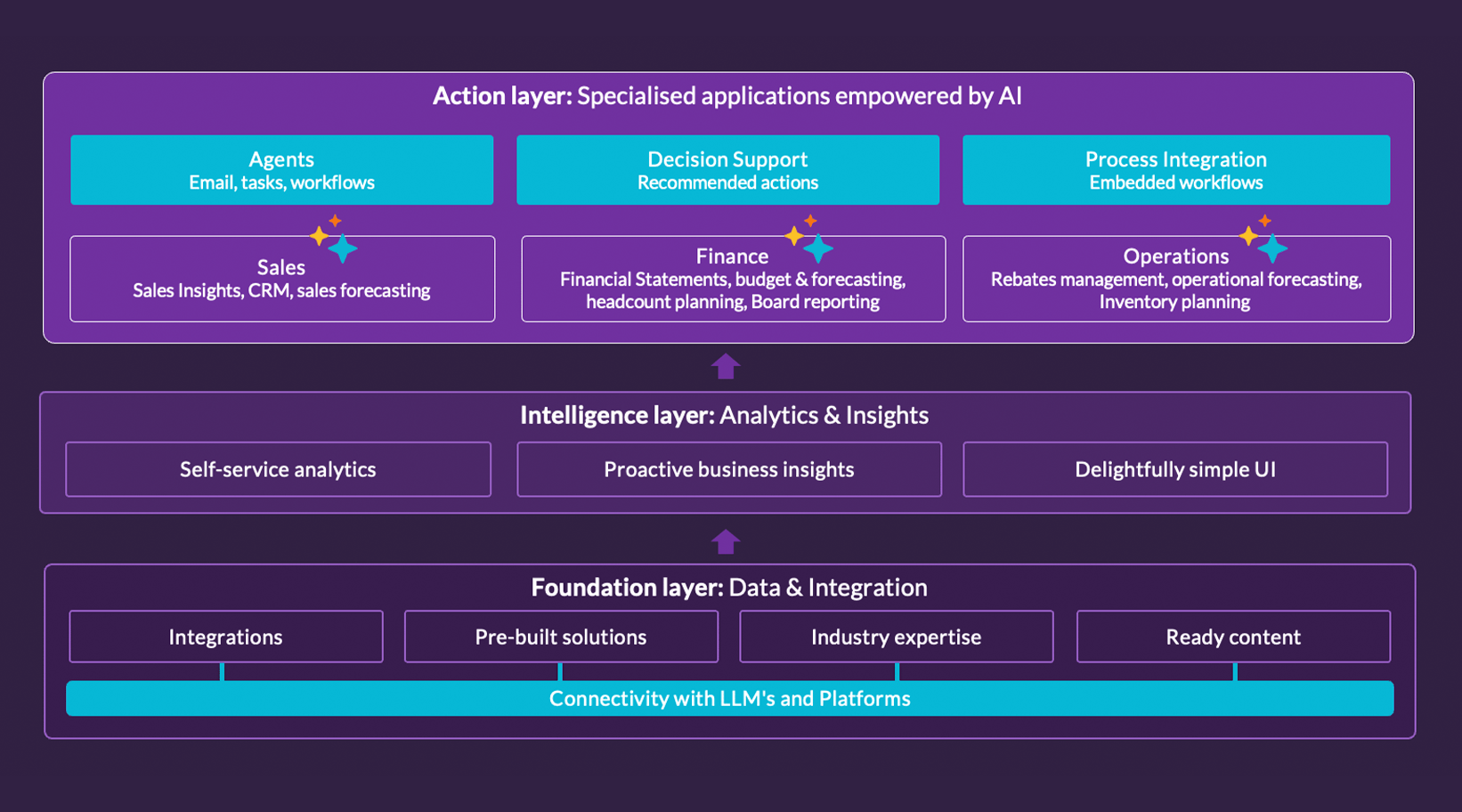
This change pushed ERP reporting beyond a single set of outputs into a layered analytics environment. Today at Phocas we have created a three-layer model, where each layer builds on the one beneath it and moves the whole business forward rom sales to operation and finance all doing their work on the same platform.
Layer 1: The foundation layer
The foundation layer is where reporting starts to become powerful. It sits beneath dashboards and analytics tools and focuses on data integration, modeling and governance. This layer takes the ERP data across thousands of tables and consolidates and aligns the data. It can also add more sources from other systems by validate the data flow to match how your business operates.
In Phocas, this foundation layer is purpose-built for the vertical industries of manufacturing, distribution and retail. This thoughtful design is important because these industries have complex data needs from multi-warehouse inventory allocations, rebate structures, tiered pricing rules and margin shifts that are always happening across channels. A strong foundation layer makes that complexity usable by building a single source of truth across ERP data and adjacent data sources such as CRM platform or HR systems.
The foundation layer presents data in user-friendly ways from the ERP software. It ensures that every KPI, metric and number in the reporting system uses consistent definitions, so different departments agree on the numbers, especially the finance team.
When the foundation layer is right, automated reporting is possible and so people have access to real-time information.
Layer 2: The intelligence layer
Once data is integrated and governed, the next step is to put it in the hands of the people who need it. This is the business intelligence layer or the self-service environment where users explore real-time data through dashboards, data visualization and interactive reporting tools. Teams across sales, finance and operations can perform their own data analysis, create custom reports and manage performance quickly.
In practice, this layer provides autonomy in the reporting process. A user-friendly interface with drag-and-drop controls allows people to filter, sort and re-group data how they want. You can drill down from a graph or trend line into the underlying transactions to find root causes, such as why profitability dropped in a specific region or why a customer has stopped buying from you. They can compare KPIs across periods, product categories or customer groups, and then see these views into dashboards that update in real time.
Users can still export clean datasets into spreadsheet formats, while staying anchored to Phocas, the add-on business intelligence layer or the quasi ERP reporting system. The BI layer also complements tools like Power BI when businesses want additional visualization options; the key is that the BI layer delivers trustworthy, real-time insights directly from consolidated ERP data.
With broad self-service adoption, stakeholders across sales, finance and operations gain the same visibility. That shared visibility is what turns reporting into alignment and faster decision-making.
Layer 3: The action layer
Business intelligence helps you understand what is happening and why. The action layer closes the loop by embedding analytics into daily workflows and tailoring reporting tools to specific roles. This is where ERP reporting has really moved from dashboards into applications designed explicitly for the way different departments work.
For sales teams, the action layer includes CRM-style customer views, sales forecasting, and performance analytics that highlight which products are growing, which customers are at risk, and where reps should focus next. There is also Phocas Sales Insights where the software helps sales professionals segment customers into groups based on recency, frequency and monetary value so they know who to talk to and what about each day.
For finance, the layer delivers financial reporting which then supports budgeting, forecasting and scenario planning with connections to ERP data. Finance leaders can see financial performance drivers as they evolve and can monitor cash flow . For operations teams, the action layer brings rebates, supply chain intelligence, pricing strategy and operational forecasting into focused applications. Instead of searching through generic reports, teams can act on low margins, stock imbalances, supplier performance and demand signals directly inside the reporting system.
The beauty of this layer is that it streamlines work. It does not ask users to build everything from scratch. It provides role-based templates, proven metrics and workflows that fit common questions in manufacturing, distribution and retail.
The next enhancement is AI intelligence agents
The three layers already transform ERP reporting, but AI is about to accelerate the shift. AI intelligence agents will sit across the foundation, BI and action layers, turning a reporting system into a proactive decision partner. Instead of people checking dashboards, agents can monitor real-time reporting feeds, detect anomalies in complex data and push real-time insights to the right stakeholders.
In a practical sense, that means automated reporting becomes smarter. An AI agent might spot an unexpected fall in profitability, identify the likely drivers, and send an email to the sales and finance teams with a clear explanation and recommended next steps. Another agent could watch supply chain trends, flag inventory risks, and trigger workflows that re-balance purchasing or pricing. Over time, these agents will embed decision-making into daily operations by managing alerts, coordinating tasks and keeping teams focused on the highest-value actions.
Maximizing ERP value with a layered approach
If your ERP system is the heart of your operational truth, then this type of ERP reporting that Phocas delivers is the nervous system. These layers are designed to help business people react quickly and intelligently to business performance across manufacturing, distribution and retail.
By using Phocas BI and FP&A business people in these three verticals automatically gain the full three-layer approach. A purpose-built foundation layer that integrates and consolidates ERP data and other sources into a trusted data engine. Then a self-service business intelligence layer where teams across different departments can explore real-time data, build dashboards and create ad hoc custom reports and an action layer with role-based applications for sales, finance and operations that allow forecasting, budgeting, cash flow, pricing, rebates, inventory and supply chain optimization. The result is that ERP reporting becomes visual and real-time so business people can use the information confidently every day to maintain profitability, find growth opportunities and stay ahead.
Top 7 essential KPIs for executives
Download now


Empowering businesses with intuitive data analytics, driving informed decisions for growth and profitability. We make people feel good about data.
Related blog posts



Browse by category
Find out how our platform gives you the visibility you need to get more done.
Get your demo today