Phocas tops ease of use rankings in BARC The planning survey 2026
Ease of use is one of the most consistent things customers say about Phocas. It comes up in case studies and customer conversations. It is this phrase or the word ‘intuitive’ that appears most reliably when users describe what they like most about the planning tools. When BARC The Planning Survey 2026 results came in, it was reassuring to see that consistency reflected in the independent research.
Phocas achieved top rankings for ease of use across three peer groups in which we qualified in the world's largest and most comprehensive planning survey. These groups are planning, budgeting and forecasting software; integrated products for planning, business intelligence and analytics and midsize/departmental implementations.
What the BARC results mean?
BARC The Planning Survey 26 evaluates FP&A software across dozens of key performance indicators based on responses from actual customers. This means a top rank in ease of use is not a reflection of Phocas's own claims rather it reflects the experience of customers, scored against peers in their market segment.
Across all three peer groups, Phocas users consistently rated the product as easy to use. That's a meaningful result in the sophisticated planning category. Ease of use can be lost in powerful financial planning and analysis tools as often they are built for the specialist-trained power users and therefore often only used by a few people.
The broader results of the survey reinforce that Phocas planning tools are adopted and useful in many different teams within a distribution business. With 4 top ranks and 16 leading positions in total, Phocas achieved a strong overall performance in this year's Planning Survey. BARC analysts also highlighted a top rank achievement for Phocas in Predefined Connectors within the Integrated Product for Planning and BI & Analytics peer group, as well as high ratings across KPIs including Project Length, Planning Content and Reporting/Analysis. This set of results highlights a product that's fast to implement, well-connected to existing ERP systems and usable by all.
As the BARC analyst noted, "With 4 top ranks and 16 leading positions, Phocas achieves a strong set of results in this year's Planning Survey. High ratings in KPIs such as Ease of Use, Project Length, Predefined Connectors, Planning Content and Reporting/Analysis underline Phocas's solid position in the midsize and departmental planning software market."
Why ease of use matters in FP&A
FP&A tools have a reputation for being powerful but complicated. Enterprise platforms built for large finance departments are complex, so if mid-market organisations use these tools that difficulty is also what they contend with when using the tools. Usually adoption outside the finance team remains low so people working in branches aren’t privy to financial statements or dashboards of financial performance information.
A budgeting and forecasting or financial reporting tool that only the CFO and financial controller can use is not suitable for distributors, so that’s why the Phocas approach is different. With Phocas Budgets & Forecasts, business partners across the organisation get controlled access to help the finance teams build budgets and share their expertise in the process. Department heads own their numbers and budgets are more accurate because the people closest to specific headcount planning are contributing to them.
Phocas Financial Statements was also designed with the all-in approach so that every branch or division received regular statements or management reporting about how they are performing.
What customers are saying in the survey and outside of it
The survey results come from real users, and the pattern in their comments is consistent that Phocas is easy to pick up. We also compared the comments to what other customers have also told us about their user experience.
A business employee in manufacturing summed up Phocas plainly, "It's relatively simple and easy to use."
Daron Brown, VP of Purchasing and Inventory, put it more vividly, "One of the things I like best about Phocas is it's like teaching your grandmother how to use an iPhone. It is super simple to pick up, it's intuitive, it's user friendly right out of the gate. You don't have to be a programming nerd to figure it out."
That kind of accessibility is key in operational planning environments where the users aren't always finance people. Sales managers overseeing many branches, purchasing managers reviewing demand plans, operations leads forecasting inventory; these are tasks that can be made easier in Phocas Financial Statements and Budgets and Forecasts. The ease of use rankings reflect that design intent working in practice.
It also helps explain the 91% recommendation rate. According to the BARC survey, 91% of Phocas users say they would "definitely" or "probably" recommend Phocas to other organisations. A number BARC described as a strong indicator of customer satisfaction with both the vendor and its product. Software that's easy to use tends to be software that people keep using and recommend.
What these survey results mean for finance teams evaluating FP&A tools
If you're a finance team in the mid-market distribution industry evaluating FP&A software, ease of use is probably already on your criteria list, but it's worth being specific about what you're measuring.
Ease of use for the CFO setting up the model is different from ease of use for the sales manager submitting their numbers for the budget. Ease of use in month one is different from ease of use five months after go-live.
The BARC Planning Survey 2026 reflects what users are experiencing across organizations of different sizes and functional backgrounds.
For mid-market businesses considering Phocas Analytics, Budgets & Forecasts and Financial statements, the results provide independent validation of what Phocas customers consistently report. Customers achieve connected planning quickly and teams working across sales, operations and finance all use the tools.
Phocas in the BARC Planning Survey 26
Download now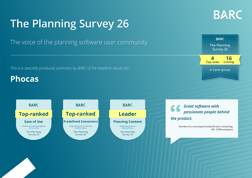


Katrina is a professional writer with a decade of experience in business and tech. She explains how data and AI can work for distribution professionals and finance teams without all the tech jargon.
Related blog posts

Phocas is launching Tomorrow's Distributor, a new interactive learning series designed to help sales and finance professionals tackle everyday business challenges, make better use of their data and prepare for the future of distribution. We know the distribution industry is constantly changing. This year consolidation has proliferated, especially in America, where merger and acquisition transactions are up 7.7% year over year according to AXIA data. These new, larger companies create complex working environments that require systems that can ingest data from many systems into one platform for multi-entity reporting and consolidation. At the same time, 49% of distributors are using AI for sales but with limited impact according to our new State of Sales in Distribution Report. As Phocas works with distributors every day, we decided to respond to these changes by offering a free program to address some of these data and tech challenges featuring Phocas experts and customers.
Read more
Epicor has been named the winner of the inaugural Phocas Partner Awards in the global category, marking 18-years of partnership. Epicor leads the way among Phocas' global partners in delivering customer value and success.
Read more
Our partners help distribution and manufacturing businesses get more value from their technology by understanding how ERPs and other systems work together, so teams can access the data they need and operate more efficiently. They also stay ahead of change like AI so they can give customers informed advice. We want to celebrate the partners driving that customer success, so this year, we're recognizing their work for the first time with the Phocas Partner Awards.
Read more
Mapping your general ledger accounts to a financial statement is one of those jobs everyone in finance knows and nobody wants to mess up. Whether you call it account mapping, GL mapping or GL coding, it is matching every account in your chart of accounts, line by line, to the right row on the P&L (income statement), balance sheet or cash flow. Miss one account or mis-map another and the numbers don't reconcile. Get it right and it takes hours but it is longer again if you're rolling the work out across multiple entities, branches or depots. Phocas Financial Statements has just added two features that change this. A Statement Library of ready-to-use report templates and AI-suggested account mapping with confidence scoring. Together, they turn an important manual setup task into something you can replicate and trust.
Read moreBrowse by category
Find out how our platform gives you the visibility you need to get more done.
Get your demo today