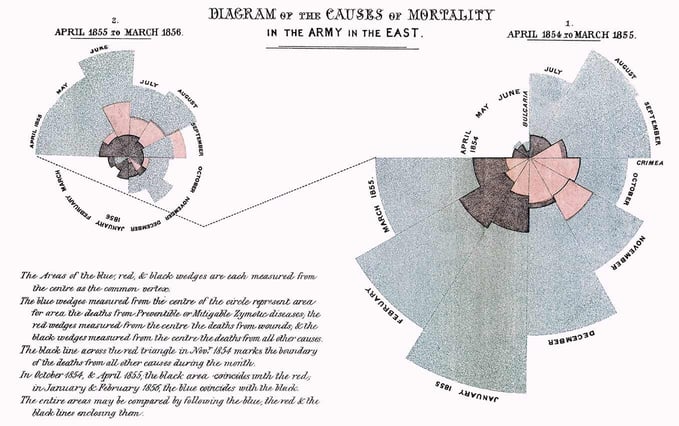
Using data to make data-driven decisions can be traced back to the 1800s where the English social reformer and statistician, Florence Nightingale pioneered the use of applied statistics and created visual ways of displaying data. One of her earliest diagrams is listed below.
The 1960s
Fast forward to the 1960s and the first computer applications were developed for transaction processing. Although these reports of processed data assisted decision makers, the information they offered was inconclusive.
Due to the demand from corporates and early work by Harvard University and the Massachusetts Institute of Technology (MIT), data-driven intelligence platforms began to evolve. The University of Georgia’s, Hugh Watson asserts that it was the work of Michael Scott Morton in 1967 that led to the development of management decision systems to assist managers in making fact based decisions. These systems were developed across the 1960s and 1970s primarily by academics with management backgrounds.
A Definition of Business Intelligence
More recently, the term ‘business intelligence’ or ‘BI’ was first coined and promoted by the former Gartner analyst, Howard Dresner in 1989. Business intelligence can be defined as:
“A broad category of applications, technologies, and processes for gathering, storing, accessing, and analyzing data to help business users make better decisions.”
Business intelligence is not just about an application – it also refers to technologies and processes. The premise of business intelligence is not just to get data out (through tools and applications), it is also about getting data in (to a data mart or warehouse).
Thinking about business intelligence may conjure up memories of piles of paper being flung around an office. Getting the data you need to make data driven decisions was like finding a needle in a haystack. To even have a business intelligence tool embedded in your organization would only occur when there was significant buy in and support from internal decision makers.
The 1990s
In the 1990s, if a decision maker wanted a business intelligence tool, they would often go to an enterprise business intelligence vendor. At that point, a complicated project plan would need to be created which may involve speaking with internal departments and deciding on what their needs are.
In addition, the IT team would need to be trained on how to use the BI tool and expensive consultants would often need to be hired. It could take 6-12 months before a BI solution would finally be introduced into an organization.
After the business intelligence solution was introduced, there were many difficulties. For example, once the IT team or Project Manager put the BI tool in the hands of business users, most staff couldn’t use it. Very few could create their own reports and they had to go to the IT team who were highly trained and ask them the questions they need answers to.
It was not unusual for it to take 5-7 days before the IT team produced the report. By that time, the user has often forgotten the question they asked in the first place.
To recap, just 25-30 years ago, business intelligence systems were not very effective and they tended to be IT led due to the complications of the tools at the time. BI software was costly and businesses often had to pay large sums for consultants. Many businesses had to purchase expensive hardware and internal costs were high as staff had to be trained up to use the tool.
Click through the SlideShare below to walk through the history of business intelligence.
In part two of this three part series, we discuss the present, where business intelligence tools have started to provide major benefits to decision makers and a wider variety of employees.


Empowering businesses with intuitive data analytics, driving informed decisions for growth and profitability. We make people feel good about data.
Related blog posts




Browse by category
Find out how our platform gives you the visibility you need to get more done.
Get your demo today Analytics
  Financial Statements
  Budgets & Forecasts
  Rebates
  CRM
CRM  Sales Insights