CRM and Business Intelligence: From Data to Decisions
More than a year ago, we addressed the ongoing debate about whether Customer Relationship Management (CRM) or Business Intelligence (BI) is the better analytical solution for your business.
As a company, we take the position that data is good whether you're driving the customer experience or needing intelligence to clearly understand how well you are doing as a company. Regardless of what side of the line you fall, data makes it easier to make better, more strategic decisions. And this is where BI might have the advantage.
Defining CRM
CRM, by its simplest definition, is the process that companies use to track and manage contact details and interaction with current and prospective customers. In today’s world of sales and marketing automation, the CRM tool is critical at preserving how and when the company connects with customers. The CRM system is your knowledge bank about your customers that allows you to continually refine your outreach to become increasingly more focused on delivering them the right message, at the right time, through the right channel. In return, you hope to increase customer loyalty and sales opportunities.
Where BI and CRM Diverge
While CRM is focused on the customer experience to drive sales, BI is trying to better understand every part of the business to make decisions that will impact overall profitability. CRM is a single data source while we like to say that BI was created to actually make sense of all the sources of data floating around your organization. From the multiple volumes of data, come insights that form the basis for what you do next as a company, not merely what your next email offer should be to a struggling customer. BI takes data from across the business to help decision makers understand what can improve in your business, including and beyond sales and marketing.
What Happens Next?
While CRM and BI converge on the idea that data is important, ultimately, the key differentiator resides in what happens next with the information.
BI actually builds on CRM systems, presenting real-time actionable insights via charts, graphs and infographics that help identify trends. Phocas makes it easy to build Dashboards that present the latest information about everything from inventory to finance. Our intuitive mobile interface also enables access to data from anywhere and from any device. Certainly, CRM systems provide a mobile component, but in most cases, it’s used to access contact information or to track a touch point with the customer. Our BI software provides instant access to information that is relevant and useful, allowing you to see what is happening across your business at any time and from anywhere so you can make more timely decisions.
From Data to Decisions
In our previous blog about this topic, we were clear that BI tools and CRM systems were built with a different purpose, and that’s why both are important to your business. They both gather data, but in the end, only one solution looks at the bigger picture. Phocas was designed for the entire business, making it easy for decision makers across the organization to access and visualize detailed analytics so they can turn information into action.


Empowering businesses with intuitive data analytics, driving informed decisions for growth and profitability. We make people feel good about data.
Related blog posts

Epicor has been named the winner of the inaugural Phocas Partner Awards in the global category, marking 18-years of partnership. Epicor leads the way among Phocas' global partners in delivering customer value and success.
Read more
Our partners help distribution and manufacturing businesses get more value from their technology by understanding how ERPs and other systems work together, so teams can access the data they need and operate more efficiently. They also stay ahead of change like AI so they can give customers informed advice. We want to celebrate the partners driving that customer success, so this year, we're recognizing their work for the first time with the Phocas Partner Awards.
Read more
Sales reps spend just 40% of their workweek selling, according to Salesforce's 2026 State of Sales report, which surveyed more than 4,000 sales professionals across 22 countries. The remainder is taken up by activities including research, planning, internal work and admin. That's an industry stat but it's also the problem we're fixing. Reps don't avoid CRM because they don't care about pipeline discipline. They avoid it because typing notes into a desktop tool between meetings isn't how they work. So, notes don't get logged, the pipeline goes stale, and the sales forecast follows.
Read more
Food and nearly everything else that is bought and sold must travel from where it is produced to the buyer. Transportation costs are rising sharply. Oil prices have surged by approximately 45% and gas by 55% since late February, a direct consequence of the escalating conflict in the Middle East. Distributors and their supply chain managers have been up against inflation and rising prices since the pandemic and and to cope with continuing shocks like the Middle East crisis most have had to change their supply chain processes to manage a more volatile marketplace. Business intelligence (BI) helps distributors understand risk exposure and make confident decisions when the range of possible futures runs from bad to considerably worse.
Read more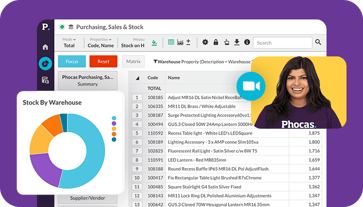
Find out how our platform gives you the visibility you need to get more done.
Get your demo today