Wholesale distributors rely heavily on data to guide inventory management across thousands of SKUs and complex supply chain operations. With variables like gross margin, cost of goods sold (COGS) and inventory turnover, professionals working across a distribution business need to determine what’s relevant to them as well as how they work together.
One useful metric some distributors use is the Turn and Earn Index (T/E Index). The Turn/Earn index, sometimes called the T/E index, helps balance the gross margin percentage earned on an item with how frequently that item sells over a given period. By looking at both profitability and turnover together, distributors gain another perspective on inventory performance and whether a SKU is delivering an appropriate return relative to the inventory required to support it.
For organizations already tracking a wide range of inventory KPIs (key performance indicators) such as gross profit, average days of supply and daily sales, the T&E index can act as another critical approach to measuring inventory. It connects pricing strategy with how effectively inventory moves through the business.
The idea behind the Turn and Earn Index
The Turn and Earn Index (T/E Index) measures how effectively a product converts inventory investment into profit over a defined period. It combines two familiar inventory KPIs - gross margin and inventory turnover. Gross margin percentage shows the profit margin you earn on each sale after accounting for cost of goods sold (COGS), while inventory turnover measures the number of times inventory sells through during a year. Looking at these two metrics together provides a useful perspective on inventory performance, helping distributors understand whether a product is generating sufficient return relative to the inventory required to support it.
When the two metrics are combined, they reveal what inventory is working for the wholesale distributor. For example, a commodity item with a 25% gross margin that turns eight times per year can generate a similar return to a specialty item with a 50% margin that turns four times annually. Although the products differ significantly in pricing strategy and turnover, the Turn and Earn Index shows the two products can perform equally well for the business even if they behave very differently.
For distributors managing large product assortments, this perspective helps connect pricing and stocking decisions with overall inventory management and gross profit outcomes and helps them to make key decision about their portfolio.
Using the Turn and Earn Index to identify underperforming SKUs
Consider a distributor managing a large product line that includes both commodity and specialty items. Many of the fast-moving SKUs may follow a standard pricing rule such as 25% gross margin percentage and typically turn inventory eight times per year. But within that same category there may be another SKU priced using the same margin rule that only sells four times per year. This item may not immediately stand out in standard reports, especially when looking at annual sales, gross profit, or COGS in isolation. However, when viewed through the Turn and Earn Index, the difference becomes clear. The fast-moving commodity item generates a stronger balance between gross margin and inventory turnover, while the slower item delivers a lower return relative to the average inventory investment required to stock it. For distributors managing thousands of SKUs, this kind of analysis helps highlight opportunities for inventory optimization.
When a SKU falls below your T/E index benchmark, it signals that something may need to change. Distributors might first evaluate pricing and determine whether the item could support a higher profit margin, increasing its gross margin return on investment (GMROI) even if the item moves more slowly. Another option is to reduce the average inventory value held for that SKU. Lower average inventory investment can increase inventory turnover, improving overall inventory performance while maintaining an acceptable service level through better forecasting and supply chain coordination. In some cases, distributors may also decide to stop stocking the item altogether. Slow-moving, low-margin SKUs can consume warehouse space and contribute to stockouts elsewhere. By combining insights from the turn/earn index with related metrics like GMROI, distributors can better understand how gross profit, inventory turnover and average inventory value work together to generate annual gross profit across the business.
Why the Turn and Earn Index is more useful as SKU counts grow
As the number of SKUs increases, it becomes more difficult to identify performance patterns across an entire product portfolio. Distributors managing a few hundred items may be able to spot slow movers or inconsistent pricing patterns through routine reporting. However, organizations managing 10,000 or more SKUs rely heavily on key performance indicators to evaluate inventory performance. Metrics like gross margin, days of supply, sales and average inventory value already play an important role in monitoring operations, but the Turn & Earn Index introduces another analytical lens that connects profitability with how efficiently inventory moves.
By combining gross margin percentage with the number of times inventory turns during a given time period, the T/E index can help distributors quickly highlight underperforming SKUs, establish a useful benchmark across similar items, and prioritize pricing or stocking reviews. It also supports more effective forecasting by identifying products that tie up excess average inventory investment relative to the gross profit they generate. When used alongside other inventory management metrics and GMROI, the turn/earn index can help streamline decision-making across purchasing, pricing and supply chain teams while reducing the risk of low inventory, stockouts and inconsistent service levels.
Calculating a turn and earn index with Phocas Analytics
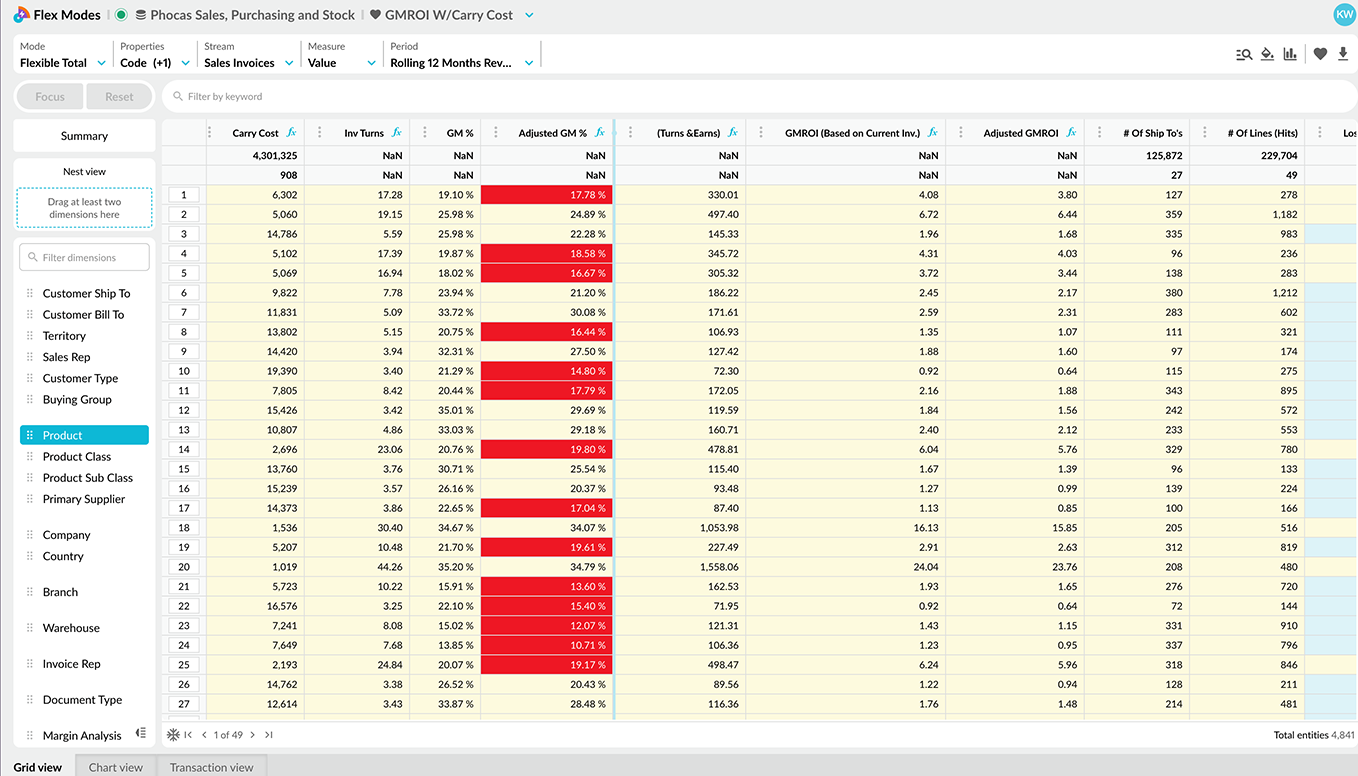
With Phocas Analytics, wholesale distributors can calculate and monitor a Turn and Earn Index by bringing together data from sales, finance and inventory databases into a single analytics environment. Using Flex Modes, teams can combine key fields such as sales rolling 12, cost of goods sold 12, gross margin, average inventory value current to calculate the relationship between inventory turnover and profitability across any product line or SKU. As Phocas sits on top of operational ERP systems it enables distributors to work directly with trusted operational data while building new analytical metrics that support more detailed inventory management and supply chain visibility.
Optimize stock
Watch now
Once these data points are connected, distributors can use Flex Modes to create calculations that measure how effectively inventory is generating annual gross profit relative to the average inventory investment required to stock it. Metrics such as average quantity sold monthly, carry cost %, inventory turns % and gross margin % can be combined into dashboards that create the turn/earn index alongside other important KPIs like GMROI. This allows teams to evaluate inventory performance, compare results across SKUs and quickly identify opportunities for pricing, stocking, or forecasting optimization, turning the turns and earns index into a practical tool for data-driven inventory management.
Inventory trends in wholesale distribution
Download now


Katrina is a professional writer with a decade of experience in business and tech. She explains how data and AI can work for distribution professionals and finance teams without all the tech jargon.
Related blog posts



Browse by category
Find out how our platform gives you the visibility you need to get more done.
Get your demo today