What is decision intelligence?
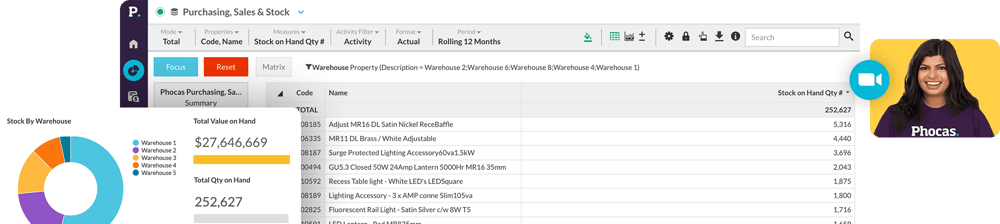
Find out how our platform gives you the visibility you need to get more done.
Get your demo todayWhat does decision intelligence mean?
Decision intelligence brings together business data, analytics and models to help people choose and evaluate actions. It connects insights with business goals, helps teams assess possible outcomes and uses feedback from results to improve future decisions.
The starting point is a decision, not simply a dashboard or an AI answer. A business defines what it is trying to achieve, identifies the available options and considers the constraints, trade-offs and evidence behind each choice. People or governed processes then act and review what happened.
How does decision intelligence relate to BI and FP&A?
Business intelligence (BI), financial planning and analysis (FP&A), and decision intelligence have overlapping roles:
- BI helps teams understand performance and investigate what has happened or is happening.
- FP&A connects operational and financial information through budgets, forecasts, scenarios and performance analysis.
- Decision intelligence makes the choice of action explicit: what are the options, which goals and constraints matter, and how will the outcome be evaluated?
These are complementary approaches, not a rigid maturity ladder. BI can include predictive and prescriptive analysis, and FP&A already supports decisions. Decision intelligence provides a framework for connecting those capabilities to a repeatable decision process.
What could decision intelligence look like for a distributor?
Consider an illustrative distributor whose gross margin has fallen. BI helps the team investigate whether the change comes from product mix, purchase costs, pricing or customer discounts. FP&A can model how different responses could affect revenue, margin and cash flow.
The decision process then compares actions. The team might review discounts on selected accounts, negotiate purchasing terms or change its product mix. Each option has constraints: customer agreements, available stock, service levels and the risk of losing sales.
A decision owner reviews the evidence and trade-offs, approves an action and defines how success will be measured. The team then monitors margin, sales volume and customer behavior and revisits its assumptions. This is an example of a decision process, not a claim that Phocas automatically performs or executes every step.
What are the main steps in a decision intelligence process?
- Define the decision. Set the objective, decision owner, time horizon and measures of success.
- Bring together relevant evidence. Check the data, metric definitions and business context needed to understand the situation.
- Compare options. Consider expected outcomes, uncertainty, business rules and practical constraints.
- Decide and act. Make responsibilities and approval boundaries clear.
- Review the outcome. Compare results with expectations and use the learning to improve the next decision.
The process can begin with one recurring business decision. It does not require an autonomous system or a new tool for every step.
Does decision intelligence require AI or automation?
No. A structured approach to decisions can use business rules, analysis, scenarios and human judgment without generative AI. AI can help interpret information, summarize evidence or support the comparison of options, but its role depends on the use case.
Decision support and automated execution are different. A recommendation does not authorize a system to change a price, place an order or commit spending. Any automation needs clear limits, permissions, monitoring and appropriate approval.
Why do data quality and human review matter?
A confident answer can still rest on incomplete data, an unsuitable assumption or a metric that means something different to the decision maker. Check data freshness, coverage and definitions, and consider what the analysis cannot establish.
People bring context that may not be captured in a model, such as a supplier negotiation or a customer commitment. Clear ownership and review help teams challenge recommendations, document their reasoning and learn from outcomes. Feedback should improve the process rather than be treated as proof that every earlier recommendation was correct.
How does decision intelligence relate to Phocas?
Phocas brings together connected business data, analytics and financial planning capabilities that help teams investigate performance and assess options. Workspaces, powered by PACE, adds conversational exploration of modeled data within existing Phocas permissions. Users can review the steps behind an answer and open results in Analytics to check the detail.
Workspaces is currently in beta. Phocas presents broader decision intelligence as a direction for the platform on its AI roadmap. That future direction should be distinguished from the features available to a particular customer today; it is not a promise that every decision can already be recommended or executed automatically.
Explore Phocas Analytics, Budgets & Forecasts and Workspaces to understand the current experiences, and speak with your Phocas team about availability.
For the broader distribution perspective, read Decision intelligence for distributors.
Understand the past, operate better today, and plan well for the future