Decision intelligence for distributors
A purchasing manager at a wholesale distribution company makes hundreds of decisions every week which involves many different data sets and departments. Reorder this SKU or wait? Approve this customer's credit extension? Switch suppliers on this product line? Adjust pricing on a slow-moving category? And now with the rise of machine learning many of these decisions will be automated.
Gartner predicts that 60% of supply chain disruptions will be resolved without human intervention by 2031. This means many decisions currently made by professionals working across distribution businesses will be handled by decision intelligence technology and associated AI agents.
Decision intelligence platforms can automate or guide most of these decisions because they are repeatable, data-dependent and business rules can be built around them. Phocas is at the forefront of bringing this advancement to the distribution industry because we have 25 years building industry-specific software. As well as a deep understanding of the information and access of the data required to make these decisions. We want to make sure that we build a high-quality platform that can handle the full complexity of distributors’ decisions. Our aim is to change the way they operate while continuing to address current market pressures like greater competition.
What decision intelligence means in 2026
The definition of decision intelligence has evolved significantly since we last wrote about it. Early interpretations framed decision intelligence as advanced analytics with a predictive layer.
Soon the Phocas decision intelligence platform will surface accurate information that has been cross checked across various touchpoints to the person asking the question with a recommended action attached.
Current business intelligence usually informs a user on what has happened. Predictive analytics was then created to help people model what might happen. This shift to decision intelligence will provide answers of the preferred forward move given everything that is known.
For wholesale distributors this new advancement matters enormously so we want to get everyone prepared.
The complexity behind one distribution decision
In the next few months, you will start to see all existing BI tools or new AI tools being positioned as decision intelligence so you’ll need to determine if they operate on one data set or then can move between data sets. A foundation model can answer "should I reorder this SKU?" when it has access to stock or warehouse data.
If the question is more complicated like, "Should I reorder this SKU given the customer wanting the product is on a credit hold. There is also excess stock of a viable substitute product sitting in another warehouse and the margin target for this category is under pressure?"
That second question requires simultaneous awareness of inventory levels, product data, margin targets and cash conversion cycle statistics. Is this information connected and up-to-date from a range of systems and databases across inventory, finance and sales?
Currently no generic AI tool has this as it must be purpose-built for distribution so that's exactly what Phocas is doing.
Three areas where a DI platform needs to deliver for distribution
When evaluating whether a decision intelligence solution is right for your business, we believe it needs to deliver on three fronts.
1. Does it have access to all the required information? Margin erosion, stock-outs and lost customers often trace back to delayed or poorly informed decisions. A decision intelligence platform should reduce the time from data to decision but not by oversimplifying the decision, but by presenting the consolidated conclusion quickly.
2. Does it present a path forward? Surfacing data is easy. A true DI product presents a recommended next action alongside the insight. Not just "this customer's order frequency has dropped 40%" but "based on their purchase history, open credit, and current stock of their top SKUs, here's a suggested offer." The insight and the action arrive together.
3. Does the platform learn and then improve over time? Decision intelligence should not sit still, think of it has having high intelligence. A DI platform learns from decisions made such as whether a recommendation was accepted or modified by a distribution professional and due to the feedback loops improves each time. Over time, it becomes more accurate and more tailored to how your specific business operates.
The data foundation that makes it possible
None of this works without trustworthy, deeply integrated data. Garbage in, garbage out remains as true in 2026 as it ever was. Our developers think perhaps more so, given how much AI amplifies the quality (or poor quality) of its inputs.
Phocas has spent years building exactly this foundation. We integrate with over 200 data sources and especially the ERP systems that run wholesale distribution businesses. Every connected database updates automatically when source data changes so users are always working with the latest information.
For distribution businesses specifically, this integration depth is what enables genuine decision intelligence. When inventory and purchasing data, finance and sales data all live in a clean environment, the DI platform can reason across all of them simultaneously.
Empowering decisions from sales to operations
Phocas is designed so that people at every level of the business can access the insights relevant to their decisions, understand the recommended action and act.
As AI capabilities continue to develop, the distribution businesses that move ahead further will be those with the data infrastructure and decision intelligence already in place. We look forward to sharing more updates on how the new Phocas decision intelligence platform will continue to support distributors enhance their business operations.
Inventory trends in wholesale distribution
Download now


Katrina is a professional writer with a decade of experience in business and tech. She explains how data and AI can work for distribution professionals and finance teams without all the tech jargon.
Related blog posts

Everyone working in distribution needs access to CRM for different purposes. A rep might manage customers across several branches and the regional manager is overseeing multiple states and reps. Finance partners often need visibility into major opportunities or want to check the terms of a sale but wouldn't edit transactions.
Read more
One in five distributors say their most pressing sales problem is reps not knowing which accounts to prioritize, according to Phocas' State of Sales in Distribution report. Guided selling takes over the digging, telling each rep who to call, why and what to say. Working out where to focus means checking who's stopped ordering, which product lines have slipped and where there's room to sell more. Reps can do that by hand, but it takes hours across different reports. Guided selling in a CRM built for distributors brings those answers to them, ranked by revenue impact, with every next step tracked.
Read more
Phocas is launching Tomorrow's Distributor, a new interactive learning series designed to help sales and finance professionals tackle everyday business challenges, make better use of their data and prepare for the future of distribution. We know the distribution industry is constantly changing. This year consolidation has proliferated, especially in America, where merger and acquisition transactions are up 7.7% year over year according to AXIA data. These new, larger companies create complex working environments that require systems that can ingest data from many systems into one platform for multi-entity reporting and consolidation. At the same time, 49% of distributors are using AI for sales but with limited impact according to our new State of Sales in Distribution Report. As Phocas works with distributors every day, we decided to respond to these changes by offering a free program to address some of these data and tech challenges featuring Phocas experts and customers.
Read more
Aktion Associates has been named FY26 North America Partner of the Year in the inaugural Phocas Partner Awards, following 90% year-over-year growth. A leading North American ERP and business technology partner to mid-market companies in architecture, engineering, construction, distribution and manufacturing, Aktion has worked with Phocas for six years to help customers see business performance more clearly and make more informed decisions.
Read moreBrowse by category
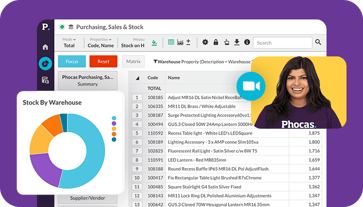
Find out how our platform gives you the visibility you need to get more done.
Get your demo today