Power BI vs Phocas for distributors
Last updated: November 2026

Compared to all the other tools that I have used, Phocas is a people-centered solution and by far the easiest. The learning curve is much less steep; whereas with Power BI, it’s vertical.
Epicor + Phocas customer
Phocas vs Power BI at a glance
Power BI

- Built for
General-purpose BI across industries - Implementation
Your team or partner builds the model and reports; timeline depends on scope - Who builds reports?
Authors build reports and models; business users explore what's published - Technical skills
Data setup and writing formulas for custom calculations, plus a separate tool to clean and prepare data - ERP & data connections
Large library of connectors. Your team designs how ERP data is organized and builds the calculations you report on. - Data warehousing
Imported data sits in the data setup behind your reports (1 GB limit on Pro, 100 GB on Premium Per User). Larger-scale warehousing runs through Fabric - On-premises data
Scheduled refresh uses a gateway you install and maintain; Pro 8 refreshes/day, Premium Per User or Fabric 48/day - Conversational AI
Copilot answers questions in reports, apps, a standalone experience and mobile, and returns answers, summaries and visuals from the semantic models users can access - What the AI answers from
The semantic model your team builds. Microsoft recommends preparing it for AI first, and questions outside the model are answered from the language model’s general knowledge. - Checking an AI answer
Model owners improve consistency with AI instructions and verified answers - Financial reporting, planning & rebates
Planning in Microsoft Fabric IQ covers budgets and forecasts but needs paid Fabric or Premium capacity. Financial reports are built by your team, and rebates are a separate product or custom build. - Sales Performance
Your team builds customer segmentation, RFM scoring and account ranking on semantic models, using custom measures - CRM
Power BI doesn’t include a CRM. Teams add Dynamics 365 Sales or another vendor’s CRM, then bring that data into Power BI to report on it alongside ERP data - Security
Permissions are set up in each report’s data setup, alongside Microsoft sign-in controls. Copilot works within each user’s data access - Support
Documentation, community, Microsoft support options and implementation partners - Pricing
Desktop is free to author in. Pro $14 and Premium Per User $24 per user per month, paid yearly (Pro is included in Microsoft 365 E5). Fabric capacity is priced separately by the hour
Phocas

- Built for
Distribution, manufacturing and retailers, with 25 years of industry experience behind it - Implementation
Dedicated team handles connections, warehousing and validation; on average, business typically launches in 8–12 weeks, subject to scope - Who builds reports?
Sales, purchasing, operations, finance and leadership build and explore their own views - Technical skills
Point-and-click analysis, dashboards and ad hoc reports, with training included - ERP & data connections
Phocas maps and consolidates data from 200+ sources including pre-built connectors to multiple ERPs. - Data warehousing
Secure data warehousing included - On-premises data
API connectors, SQL or text extracts; synced daily or as needed and managed by Phocas - Conversational AI
Workspaces, powered by PACE (beta), lets anyone ask in plain language and get an answer across multiple databases at once - What the AI answers from
Your modeled Phocas data, with your role, preferences and 25 years of distribution and manufacturing context applied. Phocas sets up the models during implementation - Checking an AI answer
Every answer shows a confidence score and the reasoning steps behind it, and opens in the Analytics Grid so you can check the transactions - Financial reporting, planning & rebates
Financial Statements, Budgets & Forecasts and Rebates available on the one platform and connected to the same data foundation - Sales Performance
The Sales Insights product segments customers by recency, frequency and spend, flags churn risk and ranks opportunities by revenue impact, as well as AI account summaries before each call - CRM
CRM is part of the Phocas platform and runs on the same consolidated ERP data + any other source as Analytics and Sales Insights. Reps can log visits and update pipeline on mobile, and AI Voice turns a 45-second recap into follow-up tasks - Security
Permissions set once per user and applied across the platform, AI included. SOC 2 Type 2 audited annually, GDPR, hosted on AWS - Support
Dedicated implementation team, then a Customer Success Consultant and ongoing global support teams, documentation, online + in-person classrooms and webinars - Pricing
Priced per product, with Analytics as the foundation, from a needs assessment. A one-off fee covers a fully managed, tailored implementation
| Power BI vs Phocas | | |
|---|---|---|
| Built for | General-purpose BI across industries | Distribution, manufacturing and retailers, with 25 years of industry experience behind it |
| Implementation | Your team or partner builds the model and reports; timeline depends on scope | Dedicated team handles connections, warehousing and validation; on average, business typically launches in 8–12 weeks, subject to scope |
| Who builds reports? | Authors build reports and models; business users explore what's published | Sales, purchasing, operations, finance and leadership build and explore their own views |
| Technical skills | Data setup and writing formulas for custom calculations, plus a separate tool to clean and prepare data | Point-and-click analysis, dashboards and ad hoc reports, with training included |
| ERP & data connections | Large library of connectors. Your team designs how ERP data is organized and builds the calculations you report on. | Phocas maps and consolidates data from 200+ sources including pre-built connectors to multiple ERPs. |
| Data warehousing | Imported data sits in the data setup behind your reports (1 GB limit on Pro, 100 GB on Premium Per User). Larger-scale warehousing runs through Fabric | Secure data warehousing included |
| On-premises data | Scheduled refresh uses a gateway you install and maintain; Pro 8 refreshes/day, Premium Per User or Fabric 48/day | API connectors, SQL or text extracts; synced daily or as needed and managed by Phocas |
| Conversational AI | Copilot answers questions in reports, apps, a standalone experience and mobile, and returns answers, summaries and visuals from the semantic models users can access | Workspaces, powered by PACE (beta), lets anyone ask in plain language and get an answer across multiple databases at once |
| What the AI answers from | The semantic model your team builds. Microsoft recommends preparing it for AI first, and questions outside the model are answered from the language model’s general knowledge. | Your modeled Phocas data, with your role, preferences and 25 years of distribution and manufacturing context applied. Phocas sets up the models during implementation |
| Checking an AI answer | Model owners improve consistency with AI instructions and verified answers | Every answer shows a confidence score and the reasoning steps behind it, and opens in the Analytics Grid so you can check the transactions |
| Financial reporting, planning & rebates | Planning in Microsoft Fabric IQ covers budgets and forecasts but needs paid Fabric or Premium capacity. Financial reports are built by your team, and rebates are a separate product or custom build. | Financial Statements, Budgets & Forecasts and Rebates available on the one platform and connected to the same data foundation |
| Sales Performance | Your team builds customer segmentation, RFM scoring and account ranking on semantic models, using custom measures | The Sales Insights product segments customers by recency, frequency and spend, flags churn risk and ranks opportunities by revenue impact, as well as AI account summaries before each call |
| CRM | Power BI doesn’t include a CRM. Teams add Dynamics 365 Sales or another vendor’s CRM, then bring that data into Power BI to report on it alongside ERP data | CRM is part of the Phocas platform and runs on the same consolidated ERP data + any other source as Analytics and Sales Insights. Reps can log visits and update pipeline on mobile, and AI Voice turns a 45-second recap into follow-up tasks |
| Security | Permissions are set up in each report’s data setup, alongside Microsoft sign-in controls. Copilot works within each user’s data access | Permissions set once per user and applied across the platform, AI included. SOC 2 Type 2 audited annually, GDPR, hosted on AWS |
| Support | Documentation, community, Microsoft support options and implementation partners | Dedicated implementation team, then a Customer Success Consultant and ongoing global support teams, documentation, online + in-person classrooms and webinars |
| Pricing | Desktop is free to author in. Pro $14 and Premium Per User $24 per user per month, paid yearly (Pro is included in Microsoft 365 E5). Fabric capacity is priced separately by the hour | Priced per product, with Analytics as the foundation, from a needs assessment. A one-off fee covers a fully managed, tailored implementation |
| Talk to an expert |
Quick set up, big wins
ICCONS found the Phocas implementation process with SAP Business One smooth and efficient, completing it in about a month. Davis, who manages the company’s systems, praised the hands-on support from Phocas and highlighted the dramatic time savings: “You just can’t compare – we used to export data into Excel and manually alter it, and now you get the same result from clicking a mouse button.”
Customer quote
ICCONS


Can your sales team get answers without waiting on IT?
With Phocas, sales reps, purchasing and operations can build their own views, filter by customer, product, rep or branch, and drill from company totals down to individual transactions without a data analyst. In Power BI, business users can filter published reports and ask Copilot questions, while new measures, data sources and report designs usually go back to a report author.
With Phocas you can:
- Analyze your data your way: use the Grid to filter and compare by customer, product, rep, branch or period
- Drill to the cause: click from company totals down to individual transactions
- Build your own reports: choose your columns and filters, add your own calculations and highlight what matters
- Create dashboards in minutes: start from a template or ask AI, add your branding and flip any widget to see the numbers behind it
-
Ask AI: Workspaces, powered by PACE (beta), answers from your business data already consolidated in Phocas, and shows a confidence score so you can check it

I love Phocas reporting, and this has helped our branches and our operations in a big way, and we can see our company performance as a whole at once. No need to check different reports to analyze data. Phocas Software is highly user-friendly compared to Microsoft Power BI.
Which works better with distribution ERPs?
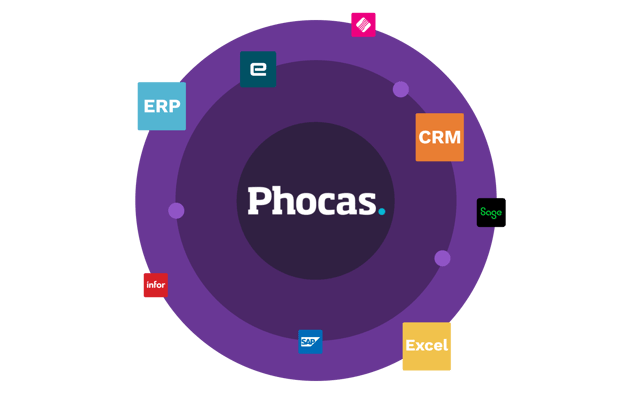
Phocas connects to the ERPs distributors run, including Epicor Prophet 21 and Infor SX.e, and the Phocas team maps and validates your data. Power BI connects to most databases too. General-purpose BI tools start empty, so someone builds the ERP connections and the data model first. Phocas arrives ERP-connected.
- Phocas holds your full sales history, including point-in-time inventory snapshots your ERP doesn’t keep.
- Phocas can consolidate multiple ERPs and sources such as CRM, spreadsheets and finance systems into one data set.
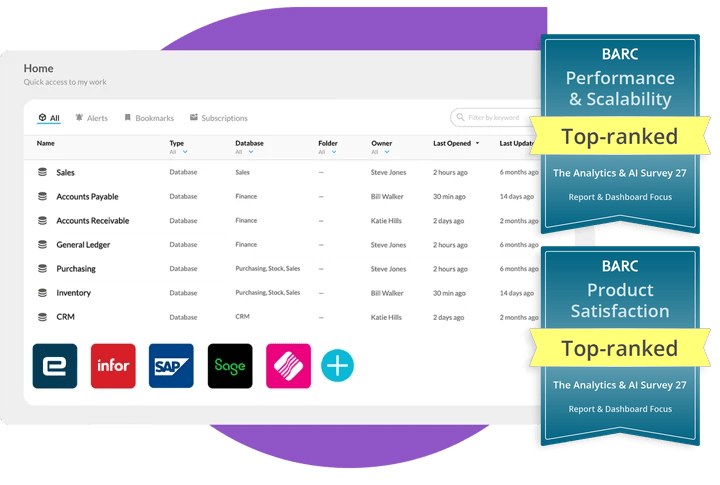
- In BARC The Planning Survey 26, Phocas was top-ranked for predefined connectors in the integrated planning and BI peer group.
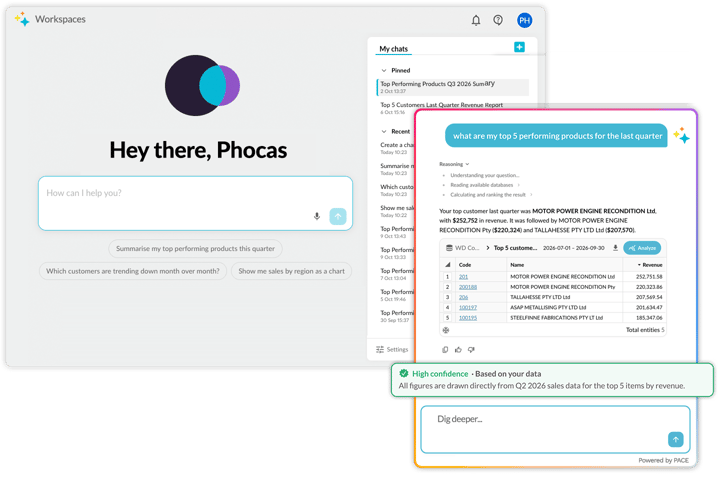
Workspaces, powered by PACE, and Copilot in Power BI
Power BI

- Conversational AI
Copilot answers questions in reports, apps, a standalone experience and mobile, and returns answers, summaries and visuals from the semantic models users can access - What the AI answers from
The data setup behind your reports that your team builds. Microsoft recommends preparing it for AI first. Questions outside the model are answered from the language model’s general knowledge - Checking the answer
Model owners improve consistency with AI instructions and verified answers - AI that builds for you
Copilot creates and edits report pages, writes formula queries, summarizes reports and describes custom calculations - AI beyond Analytics
Copilot spans Fabric workloads, and Fabric IQ brings Power BI models into Microsoft Copilot Chat. Sales and finance workflows are built by your team - Security and governance
Copilot works within each user’s existing data access, and Microsoft documents how it handles data
Phocas

- Conversational AI
Workspaces lets anyone ask a question and get an answer across multiple databases at once, with a confidence score and the steps behind it. - What the AI answers from
Your modeled Phocas data, with your role, preferences and business context applied. Phocas sets up the models during implementation - Checking the answer
Every answer shows a confidence score and the reasoning steps behind it, and opens in the grid so you can check the transactions - AI that builds for you
Ask Workspaces to build a dashboard, then review, edit and save it. Dashboard templates and AI dashboard builders help teams start - AI beyond Analytics
AI is built across Phocas, and growing. Workspaces, powered by PACE, answers your questions, Financial Statements provides AI account mapping , Sales Insights flags at-risk accounts and suggests next-best actions, and CRM turns voice notes into follow-up tasks - Security and governance
The Phocas Trust Layer is the security and governance framework behind all AI in Phocas. It brings together permissions, business context and security controls, backed by SOC 2 Type II certification, encryption by default and ongoing security testing.
| Power BI vs Phocas | | |
|---|---|---|
| Conversational AI | Copilot answers questions in reports, apps, a standalone experience and mobile, and returns answers, summaries and visuals from the semantic models users can access | Workspaces lets anyone ask a question and get an answer across multiple databases at once, with a confidence score and the steps behind it. |
| What the AI answers from | The data setup behind your reports that your team builds. Microsoft recommends preparing it for AI first. Questions outside the model are answered from the language model’s general knowledge | Your modeled Phocas data, with your role, preferences and business context applied. Phocas sets up the models during implementation |
| Checking the answer | Model owners improve consistency with AI instructions and verified answers | Every answer shows a confidence score and the reasoning steps behind it, and opens in the grid so you can check the transactions |
| AI that builds for you | Copilot creates and edits report pages, writes formula queries, summarizes reports and describes custom calculations | Ask Workspaces to build a dashboard, then review, edit and save it. Dashboard templates and AI dashboard builders help teams start |
| AI beyond Analytics | Copilot spans Fabric workloads, and Fabric IQ brings Power BI models into Microsoft Copilot Chat. Sales and finance workflows are built by your team | AI is built across Phocas, and growing. Workspaces, powered by PACE, answers your questions, Financial Statements provides AI account mapping , Sales Insights flags at-risk accounts and suggests next-best actions, and CRM turns voice notes into follow-up tasks |
| Security and governance | Copilot works within each user’s existing data access, and Microsoft documents how it handles data | The Phocas Trust Layer is the security and governance framework behind all AI in Phocas. It brings together permissions, business context and security controls, backed by SOC 2 Type II certification, encryption by default and ongoing security testing. |
| Talk to an expert |
Workspaces, Powered by PACE
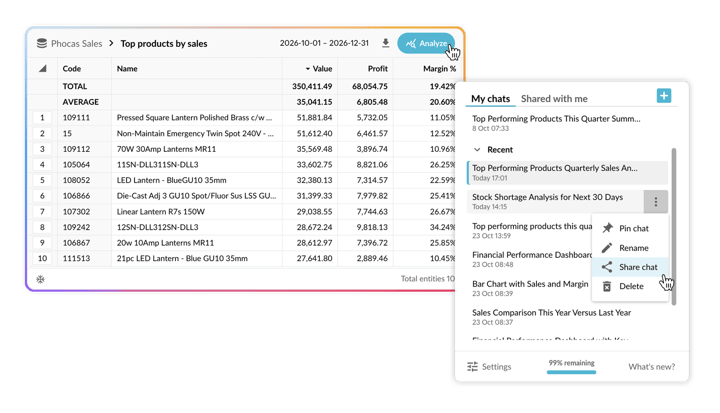
- Ask a direct question in plain English and get an answer grounded in the clean, modeled data you already trust
- Every answer comes with a confidence score
- Reasons across all your analytics databases at once
- Drill straight into the Analytics grid to verify or go deeper
- Gets smarter as you use it
- Secured by the Phocas Trust Layer
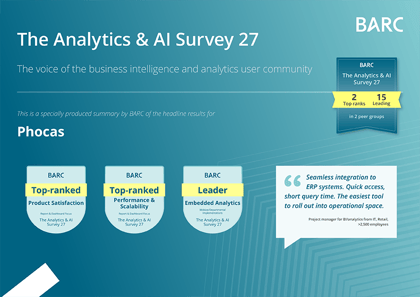
BARC The Analytics & AI Survey 27
Power BI vs Phocas
Tableau vs Phocas

Ranked #1 for product satisfaction and performance & scalability
"It‘s the king of ad-hoc analysis systems, highly flexible and user friendly, the ability to drill down to transactional level detail and back up to high level numbers in 1 or 2 clicks is great for non technical users."
Project Manager BI/Analytics, IT
Construction >2,500 employees
BARC The Analytics & AI Survey 27
Which one tracks distribution KPIs like margin and stock without custom builds?
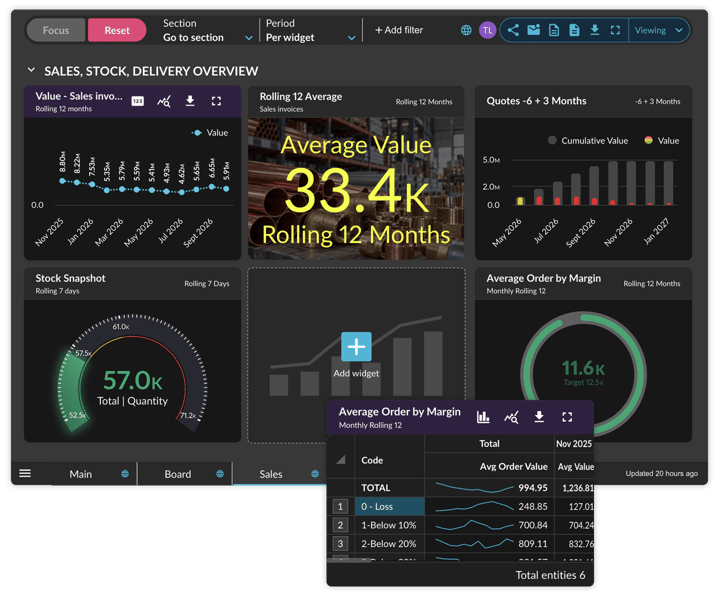
Phocas is built around the numbers distributors track, so teams report on GMROI, DIFOT and margin by customer, product and sales rep without writing formulas. KPIs for your role and industry are ready from day one. In Power BI, each of these is a custom calculation, written in DAX, that an analyst or consultant builds, tests and maintains.
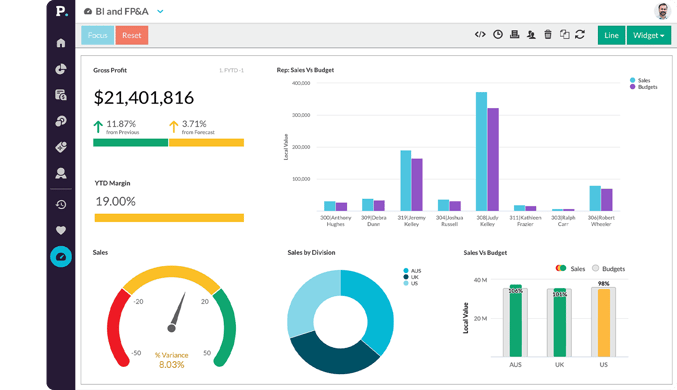
Interactive dashboards like this one are easy for anyone to build. Start from a ready-made template or ask AI (beta) to put sales, stock and margin side by side, and flip any card to see the numbers behind it.
- GMROI by SKU, product group and branch
- DIFOT (delivery in full, on time) by customer and branch
- Gross margin by customer, product and salesperson
-
Sales growth by customer and product, and at-risk accounts with Sales Insights
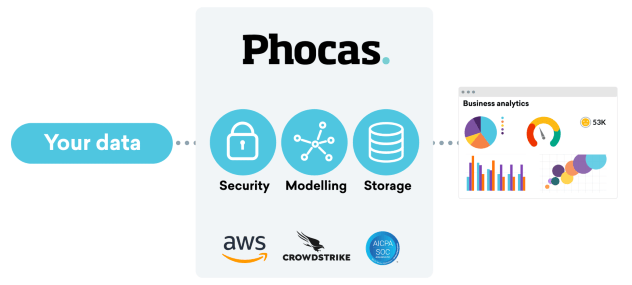
World-class data security
- We work closely with partners, Amazon Web Services (AWS) and CrowdStrike security to follow industry best practice
- We regularly review our applications, platforms, procedures, and processes
- We continually meet industry best practice with Security and Privacy compliance for SOC 2 Type 2 and GDPR
Independent mid-size companies like us, need a competitive advantage, and a tool like Phocas, allows us to compete on the same level as larger, more sophisticated companies in a real-time, cost competitive way.
Uniquely integrated platform
Phocas products share a single source of truth, with connections between Analytics, financial planning, Rebates and CRM, and between Sales Insights, CRM and Analytics.



Phocas in the BARC Analytics & AI Survey 27
See how Phocas performed in the world's largest independent Analytics & AI software survey.
Understand the past, operate better today, and plan well for the future