What is cloud business intelligence? A guide for distributors
As businesses continue to rely on analytics tools, such as business intelligence solutions, to improve decision-making and manage performance, the value of cloud-based business intelligence has become essential. Cloud BI combines powerful data integration and business analytics with the accessibility and flexibility of cloud technology, enabling companies to gain insights from anywhere.
The growing importance of Cloud BI
Cloud BI has revolutionized how companies interact with data, allowing them to be more agile in responding to market changes and to scale more easily. While cloud computing was once primarily viewed as a cost-cutting measure, it now supports digital business models, remote workforces and real-time customer connections.
In the 2024 Chartered Accountants Tech Survey, 69% of respondents reported implementing cloud infrastructure, with higher satisfaction levels in technology solutions overall. Similarly, a DELL report found that companies investing in big data, cloud, mobility, and data security experienced over 53% faster revenue growth than their competitors. The survey report findings suggest Cloud BI is essential for businesses to stay competitive in a fast-paced, AI driven world.
What is Cloud BI?
Cloud Business Intelligence (Cloud BI) integrates business data from multiple sources, organizes it into a structured data warehouse, and provides tools for BI and sales analytics and data visualization. Common data sources include ERP, CRM, and inventory systems, and Cloud BI consolidates all that data into a single cloud based ecosystem. This setup helps users identify trends, optimize stock levels and discover new growth opportunities.
What is the difference between on-premise BI and cloud BI?
On-premise BI runs on a company’s own servers, with its IT team managing hardware, maintenance, security and updates. Cloud BI is hosted by a provider and accessed online, usually through a subscription, reducing internal administration and making it easier to scale and access insights across locations. Both can connect to on-premise or cloud ERP systems, depending on the integrations available.
Use cases of cloud business intelligence
Cloud-based BI allow many more users in a company to tap into data insights and this information can be obtained with these common uses cases:
Self-service reporting - business users across the organization can independently access and analyze large volumes of data . It empowers people to explore data on demand, improving business performance with data-driven decision-making.
Integrated analytics - BI software that uses artificial intelligence, predictive modelling, and statistical analysis to uncover deeper insights and work across business functions. This approach enables business people to better understand complex data sets often with conversational analytics.
Report automation - streamlines recurring reports or dashboards by reducing the manual effort of data handling in spreadsheets. Data automation ensures business people receive timely, consistent insights, which improves workflow and supports faster decision-making.
Data visualization - Cloud BI transforms complex data sets into charts, graphs, and dashboards, making it easier to see data insights at a glance. KPIs are presented as gauges and simple charts helping business users quickly understand information and communicate findings.
The benefits of cloud BI
Cloud BI offers several advantages, including the following:
Ease of deployment – as an internet-based software, the SaaS provider can quickly setup ETL connections to a new cloud BI solution via api connectors. Business users can log-in to the BI platform and have all cloud data readily available.
Simplicity – quality cloud BI tools are designed with easy-to-use dashboards, templates and ai-powered technology so users can get up and running quickly and access predictive data insights in real-time.
Data-driven decisions - business intelligence tools provide access to real-time data and metrics so everyone in an organization from the CEO to intern can benefit from the ability to have the information they need at their fingertips.
Security - the cloud providers will have built-in data management, data security and compliance so by investing in this BI software often your datasets are more secure and cost-effective.
Mobile-friendly – employees are no longer tied to their desktops in order to access information. Cloud BI solutions are accessible from mobile phones, tablets and laptops.
Scalability – as companies increase headcount or expand geographically, adding new users to an existing cloud BI solution is simple and quick.
Reduced overheads – cloud solutions minimize the number of on-site servers and staff needed to manage day-to-day operations. Expenses that once fell to IT can be reapplied to other functions within the company.
Competitiveness – in the past, only large organizations could afford to implement software that provided business intelligence insights. With cloud expansion and its economic benefits, small and medium-sized businesses can also gain access to valuable data insights. Companies of all sizes within an industry vertical can leverage cloud BI tools, which creates a more level playing field.
What do Cloud BI solutions cost to run?
Cloud BI solutions typically charge a monthly or annual subscription, with costs depending on user numbers, features, data volumes and support. Implementation, ERP connections and training may carry additional fees, while some providers charge separately for AI capabilities or extra storage. The provider manages hosting and software updates, reducing internal IT work, but comparing the total ongoing cost means looking beyond the advertised subscription price.
How secure is Cloud BI for ERP data?
Cloud BI can protect ERP data through encryption, secure data connections and access controls that limit what each person can see. Security also depends on how the platform is configured and managed, including login requirements, software updates and monitoring. When assessing a provider, check its independent security certifications, data storage locations, backup arrangements and policies on whether customer data is used to train AI models.
Frequently asked questions
Companywide financial planning and analysis
Download now


Empowering businesses with intuitive data analytics, driving informed decisions for growth and profitability. We make people feel good about data.
Related blog posts
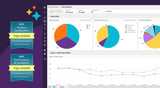
Business intelligence (BI) is valuable in distribution when people use the tool and it improves how they operate. Customer feedback in BARC's Analytics & AI Survey 27 proves Phocas Analytics, the flagship BI product on the Phocas platform supports this usability and benefit requirement, with top rankings for Product Satisfaction and Performance & Scalability.
Read more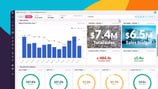
For any Sales Director, the ability to measure and communicate your team’s sales performance quickly but accurately is essential.
Read more
Conversational AI security is how you control what an AI assistant can see, how your business data is used and whether you can check its answers. For distributors, that means keeping existing user permissions, ruling out model training on your data, guarding against prompt-based leaks and verifying every output.
Read moreBrowse by category
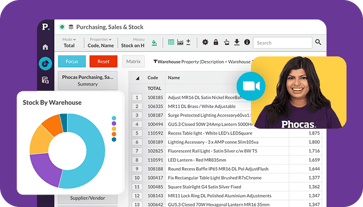
Find out how our platform gives you the visibility you need to get more done.
Get your demo today