Vena vs Phocas
Key differences at a glance
Vena

- Foundation
Excel-native FP&A platform, with AI and reporting layered on top of spreadsheet models - AI capability
Copilot and 4 GPT-4 agents (Planning, Reporting, Analytics, Query), reasoning over Excel-modelled finance data - ERP connectivity
Strongest with Microsoft Dynamics 365; other ERPs sync via generic API or SQL - Cross-functional reach
Finance led; sales and BI needs served by separately licensed add-on modules - Industry vertical fit
Horizontal, serving 15+ industries with a finance-first approach - Implementation
Often quoted at 2-3 months; independent analyst estimates put typical deployment at 3-6 months, up to 8 for complex ones - Pricing
Custom quote from ~$5,000/year, though real-world deals often run far higher
Phocas

- Foundation
Cloud-based BI + FP&A platform connecting finance, sales and operations to up-to-date ERP data - AI capability
Phocas AI reasons over governed, connected ERP data + any other source spanning finance, sales and operations - ERP connectivity
200+ sources including pre-built connectors for ERPs like Infor, Epicor, NetSuite, SAP, Sage and Microsoft - Cross-functional reach
Finance, sales and operations share one connected, ERP-native data model - Industry vertical fit
Purpose-built for distribution and manufacturing businesses planning for scale - Implementation
Fully managed setup with data warehousing, cleaning, validation and tailored config in 8-12 weeks - Pricing
Priced per product on one connected data foundation; Analytics is foundational, other modules are add-ons. Scaling up is a licence change, not a new implementation or vendor
| Vena vs Phocas | | |
|---|---|---|
| Foundation | Excel-native FP&A platform, with AI and reporting layered on top of spreadsheet models | Cloud-based BI + FP&A platform connecting finance, sales and operations to up-to-date ERP data |
| AI capability | Copilot and 4 GPT-4 agents (Planning, Reporting, Analytics, Query), reasoning over Excel-modelled finance data | Phocas AI reasons over governed, connected ERP data + any other source spanning finance, sales and operations |
| ERP connectivity | Strongest with Microsoft Dynamics 365; other ERPs sync via generic API or SQL | 200+ sources including pre-built connectors for ERPs like Infor, Epicor, NetSuite, SAP, Sage and Microsoft |
| Cross-functional reach | Finance led; sales and BI needs served by separately licensed add-on modules | Finance, sales and operations share one connected, ERP-native data model |
| Industry vertical fit | Horizontal, serving 15+ industries with a finance-first approach | Purpose-built for distribution and manufacturing businesses planning for scale |
| Implementation | Often quoted at 2-3 months; independent analyst estimates put typical deployment at 3-6 months, up to 8 for complex ones | Fully managed setup with data warehousing, cleaning, validation and tailored config in 8-12 weeks |
| Pricing | Custom quote from ~$5,000/year, though real-world deals often run far higher | Priced per product on one connected data foundation; Analytics is foundational, other modules are add-ons. Scaling up is a licence change, not a new implementation or vendor |
| Talk to a Phocas expert |
What BARC's The Planning Survey 26 says
Vena and Phocas were both assessed in BARC's The Planning Survey 26, an independent survey of over 800 users across 20 planning and BI products, fielded November 2025 to February 2026. In the one peer group where both vendors are evaluated side by side, Phocas leads Vena on 6 of the 7 shared KPIs.
Vena

- Ease of use
8.3 - Reporting/Analysis
7.6 - Performance satisfaction
8.25 - Project length (implementation)
8.1 - Predefined connectors
6.3 - Sales experience
9.3 - Planning content
7.5
Phocas

- Ease of use
8.6 - Reporting/Analysis
8.26 - Performance satisfaction
8.26 - Project length (implementation)
8.6 - Predefined connectors
7.6 - Sales experience
9.25 - Planning content
7.7
| Vena vs Phocas | | |
|---|---|---|
| Ease of use | 8.3 | 8.6 |
| Reporting/Analysis | 7.6 | 8.26 |
| Performance satisfaction | 8.25 | 8.26 |
| Project length (implementation) | 8.1 | 8.6 |
| Predefined connectors | 6.3 | 7.6 |
| Sales experience | 9.3 | 9.25 |
| Planning content | 7.5 | 7.7 |
| Talk to an expert |
Beyond the finance office
Vena's Excel-native core now extends into Vena Insights (embedded Power BI) and a separate Sales Performance Management module; both draw on the same CubeFLEX database as Vena's FP&A core. But they're separately licensed add-ons (Vena Insights is Complete-tier only) bolted on rather than included from day one.
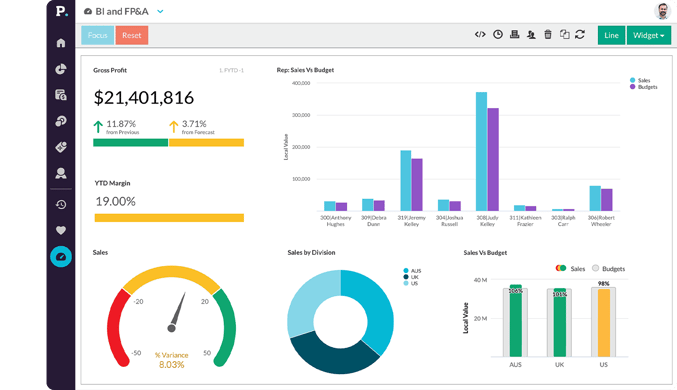
With Phocas, finance, sales and operations pull from one connected data set from day one:
- Shared numbers: sales sees the same up-to-date data finance does, no separate exports
- Operational visibility: track inventory, margin and supplier performance alongside the budget
- One version of the truth: every team works from the same governed, ERP-grounded data
Integration built around your ERP
Vena
Vena's Excel interface runs on its own database (CubeFLEX), so it isn't just spreadsheets underneath. But that database is purpose-built for financial planning and modeling data. Bringing in live operational detail, like inventory or margin, still typically means a separate BI layer or manual reconciliation.
- Central database (CubeFLEX) is built for planning and modelling data, not general operational data
- Template, model and workflow setup isn't self-service; most deployments run through Vena's professional services team or a certified partner
- Operational detail like inventory or margin usually means a separate BI layer alongside the planning database
Phocas
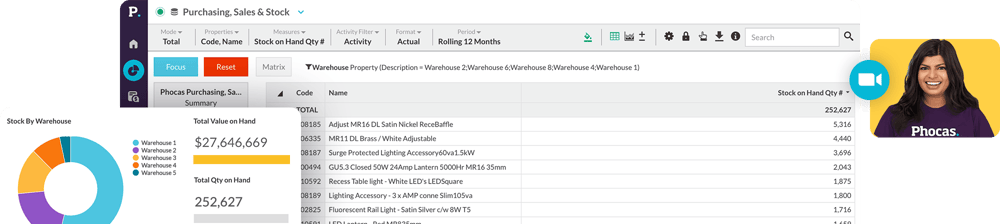
Phocas automatically brings your ERP and operational data, not just planning data, into a clean, governed cloud warehouse, so finance, sales and operations plan from the same numbers.
- One data warehouse spanning finance, sales and inventory, not a separate planning-only database
- Auto-cleans, validates and refreshes incoming data on a schedule you choose
- Supports data complexity and large volumes without extra setup
- Finance users make configuration changes themselves, without code
- Ideal for businesses modernizing and scaling their reporting infrastructure

Infor + Phocas customer
















Human-friendly tech loved by all departments

Epicor + Phocas customer
One platform, six ways to plan better
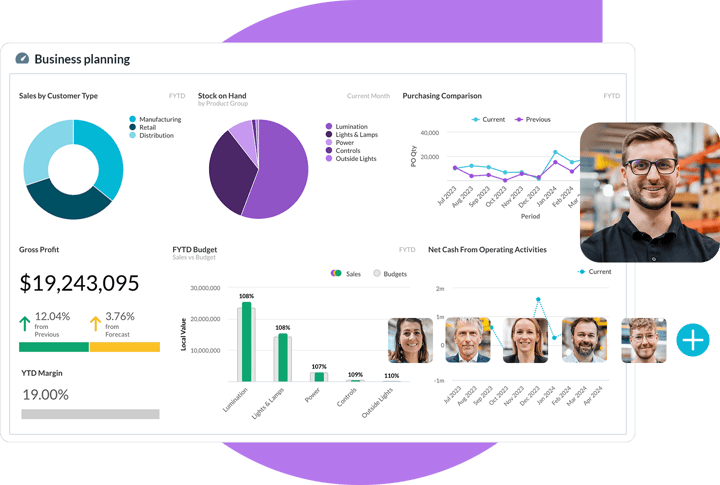
Phocas products share a single source of truth, with connections between Analytics, financial planning, Rebates and CRM, and between Sales Insights, CRM and Analytics.


Pricing
Vena
Vena doesn't publish full pricing. Two tiers are listed on its own site, but third-party transaction data shows real mid-market costs running well beyond the entry price once implementation and typical usage are factored in.
- Two published tiers, Professional ($5,000/yr) and Complete ($10,000/yr), with different feature sets and support levels
- Real-world contracts run higher: median is about $27,000/yr, with mid-market deployments (15-25 users) at $60,000-$120,000/yr
- Implementation adds $30,000-$75,000 for mid-market, plus training at roughly $1,000 per user – all-in year 1 often reaches $75,000-$250,000
- Multi-year contracts are standard, and buyers commonly report additional hidden costs of 20-35% beyond the initial quote
Sources: checkthat.ai metapraxis.com vendr.com
Phocas
Phocas prices per platform product; Analytics is the foundation, with products like Financial Statements, Budgets & Forecasts, Rebates, CRM and Insights added as your needs grow. Whichever product you're on, implementation, data warehousing, support and training are already built into the price.
- Costs stay predictable as you grow; no tiered escalations or surprise fees added after signing
- One-off implementation fee covers a fully managed, tailored setup, typically live in 8-12 weeks
- Includes data warehousing, self-serve reporting and unlimited custom dashboards, no external consultants required
- Ongoing support and platform updates are included at no extra cost; real people, not ticket queues
A secure end-to-end solution
As your data volumes and user base increase, security and governance become paramount. Rest assured, your data is safe with Phocas.

AICPA accredited



Get started in no time

Phocas in the BARC Planning Survey 26
See how Phocas performed in the world's largest independent planning software survey.
Download now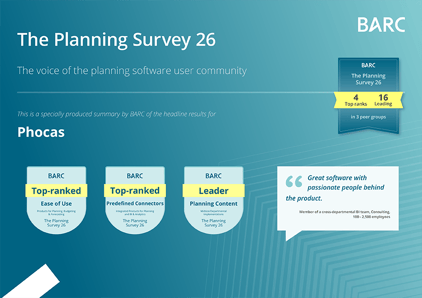
Understand the past, operate better today, and plan well for the future