Business Intelligence: The Key to Improving Medical Supply Sales
Recently I discussed four ways Business Intelligence can help medical suppliers. In this blog, we're going a little deeper to discuss the ways in which BI and analytics can help medical supply businesses improve sales.
You may think that medical supplies and Business Intelligence / analytics don't go hand in hand. But the reality is, medical supply is quite centred on supply-chain, and that in itself highlights the critical importance of analytics for every medical supplier in the industry.
Below are the four ways analytics can improve sales of medical equipment and supplies:
1. Process efficiencies
One of the key concerns for medical suppliers is to have quick and easy access to their data for analytical purposes. These days, spreadsheets are not going to cut it, especially since they will take time to produce when taking data from multiple sources.
With the advent of analytics tools and Business Intelligence, businesses have been given the ability to generate custom reports as required (to a certain extent for some tools) and present the findings in a simpler way for non-technical executives.
Ultimately, reporting and analysis can be cut down to a fraction of the time it normally takes, delivering process efficiencies. This will not only help sales people spend less time on reporting and admin, and allow them more time to work on closing sales opportunities, it will subsequently improve profitability and growth in your medical supply business.
2. Sales progress
Busy salespeople in some cases tend to forget about slow moving sales opportunities, focusing on opportunities that can close quickly. The right analytics tool can store sales opportunities to show salespeople opportunities that are stalling, so that they can revisit and act on them.
Team Medical Supplies, a hospital and healthcare equipment supplies company, have found it invaluable to have complete transparency and instant access to trusted sales figures and analysis. The company said, "We are leveraging sales data in Phocas and looking at customer buying history to assess what each customer normally buys from us and in what quantities. Our approach is to stay aligned with their typical purchasing trends and buying patterns. Data in Phocas is very helpful for managing this day to day."
For example, customer X bought so much of Y last year. This year they have yet to make an order or it’s substantially less than last years. By analysing your sales and history data not only can you identify the lost opportunity, but develop plans to address the situation.
3. Targeted campaigns
Also, to help your sales team better target customers, give them access to analytics data that gives them the necessary knowledge about their customers. It will be very beneficial for salespeople to know your customers buying patterns, requirements and preferences so that they can be more targeted in their discussions.
The ability to track and analyse sales performance across different customer types, region and product means better profiling and segmentation of customers. This in turn allows for the delivery of highly targeted and relevant sales and marketing campaigns to specific audience segments. Ultimately this means more sales, more revenue and more profit.
Identify your most profitable, dependable and low-maintenance customers. Month after month, they contribute a significant amount to your revenue and profitability. By profiling these customers you can identify and proactively prospect other customers that have similar attributes.
4. Pre-emptive actions
One of the key requirements in the medical supply industry is to always be prepared for demand by healthcare providers. If suppliers cannot anticipate demand increases, they will lose out on sales and worse, they may lose a customer. Therefore, forecasting and demand planning are key components in a medical supplier's business.
Analytics / BI tools with their ability to take historical information and translate that into projections of future demand are absolutely invaluable in this business. After all, if your business cannot meet your customer's demands, another business will. So it is very important that you stay on top of demand projections and be prepared.
The ability to forecast will also help you to navigate through challenges such as low demand or slow moving products. Additionally, tracking the performance and success of your sales and marketing campaigns in real-time gives your team a headstart to respond to problems and issues before they arise. Comprehending and acting upon accurate information early is what’s key to pre-empting unpleasant month-end surprises.
Essentially, the rewards of having the right sales information, available at the right time and in a manner that is easy to understand are numerous. To further understand the role of analytics in the medical supply industry, click the button below to download your free whitepaper.
Increase medical device sales eBook
Download now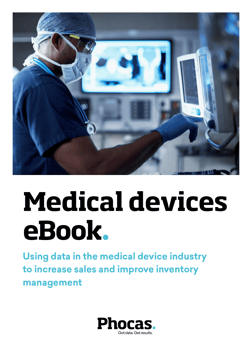


Empowering businesses with intuitive data analytics, driving informed decisions for growth and profitability. We make people feel good about data.
Related blog posts

Klipboard has been named the EMEA winner of the inaugural Phocas Partner Awards, recognizing the work its team has done to help distributors across EMEA become even more data-driven.
Read more
Epicor has been named the winner of the inaugural Phocas Partner Awards in the global category, marking 18-years of partnership. Epicor leads the way among Phocas' global partners in delivering customer value and success.
Read more
Our partners help distribution and manufacturing businesses get more value from their technology by understanding how ERPs and other systems work together, so teams can access the data they need and operate more efficiently. They also stay ahead of change like AI so they can give customers informed advice. We want to celebrate the partners driving that customer success, so this year, we're recognizing their work for the first time with the Phocas Partner Awards.
Read more
A recent Phocas survey found that half of the distribution respondents are testing general-purpose AI tools like ChatGPT and Claude on their own, outside of any business system. That's a reasonable thing to do but it is also where generic AI gets the numbers wrong for distributors in ways that are hard to know, because the answer looks exactly like a right one. It is important to know why a powerful generic AI tool can still be a wrong one and some of the important considerations of handing over your data to an AI engine.
Read moreBrowse by category
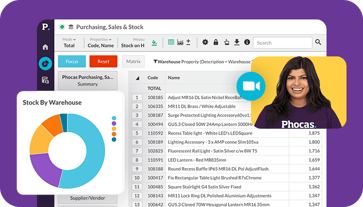
Find out how our platform gives you the visibility you need to get more done.
Get your demo today