Static reports vs business intelligence
What is the difference between traditional static reports and business intelligence (BI)? Static reports are often about a set timeframe such as the last quarter of results, and you have to consider all the elements that you'll need when preparing them. In contrast, BI takes the heavy lifting out of reporting because it populates and automates a report at any given time. In this blog, we will explore how static reports compare to real-time business intelligence so you can be better informed about what your business needs.
Going through the IT department vs. end-user access
Traditionally, reports are generated from a data source such as an ERP system. This requires your staff to go through the IT department with a request for a report, which can take up to a week for IT to generate. If it's not a standard report, generated monthly or quarterly, a longer turnaround time can be expected.
Business intelligence (BI) solutions like Phocas, however, offer end-user access, allowing managers without IT skills to quickly generate their own reports. Managers can also schedule the generation of reports at specific times, for instance every Monday morning. BI makes it easy for anyone to custom build a report with just a few clicks. Reports are easily shared with other team members; just choose your preferred delivery method. When you share a report within Phocas, the receiver only sees data relevant to them and their security settings. This time-saving feature eliminates the need to manually alter each report.
Static reports vs. analysis
A critical difference between traditional reporting and BI, is that BI offers detailed analysis. A traditional static report is good for a high-level summary that doesn’t require much detail. It may shed light on some key trends within the business. It is important to note, however, that you only receive what you know to look for. This may leave important trends undiscovered.
With business intelligence, reporting is taken to the next level. High-level overview reports are still available, but the user is able to click into the data to explore it in greater detail. For example, a report may reveal a region’s sales performance will meet expected targets, but upon drilling into the data, you may discover that one sales rep is performing beyond target, whereas another is underperforming. This is an insight you would not gain through a traditional, static, report. With BI, this insight is available with just a few clicks.
Combining data in spreadsheets vs. 360-degree insight into your business
Companies typically utilize different data sources, such as ERPs, CRMs, and spreadsheets. Traditionally, information for a report is generated directly from the data source. If more than one source is used, it can become the responsibility of the manager requesting the reports to combine the data in a spreadsheet. While spreadsheets are useful in a business, they should not be used to combine businesses data. Spreadsheets are notorious for containing errors. An error in one cell will throw off the entire report. A mistake like this is easy to make, and very hard to identify. Spreadsheet errors can cost businesses a substantial amount of revenue each year. Over time, this could become a financial disaster.
A high quality BI solution like Phocas, allows businesses to combine relevant data from multiple sources. With Phocas, when the data is explored or reports are built, you will get a 360-degree view of your business. While most managers have a general overview of what is happening in their business, BI customers are able to spot trends, and take action to prevent a problem for the business. In addition to this, Phocas customers have found trends they didn’t know existed before they started exploring their data in Phocas.
To learn how Phocas business intelligence can assist your business, download this e-Book, How Phocas benefits your IT team.


Empowering businesses with intuitive data analytics, driving informed decisions for growth and profitability. We make people feel good about data.
Related blog posts

Food and nearly everything else that is bought and sold must travel from where it is produced to the buyer. Transportation costs are rising sharply. Oil prices have surged by approximately 45% and gas by 55% since late February, a direct consequence of the escalating conflict in the Middle East. Distributors and their supply chain managers have been up against inflation and rising prices since the pandemic and and to cope with continuing shocks like the Middle East crisis most have had to change their supply chain processes to manage a more volatile marketplace. Business intelligence (BI) helps distributors understand risk exposure and make confident decisions when the range of possible futures runs from bad to considerably worse.
Read more
Inventory days formula is equivalent to the average number of days each item or SKU (stock keeping unit) is in the warehouse.
Read more
How can you maximize the business benefits from your enterprise resource planning (ERP) system? You get there by rethinking ERP reporting as a layered reporting system that turns ERP data into real-time insights, not just historical outputs. For years, enterprise resource planning platforms have been the backbone of manufacturing, distribution and retail because they capture orders, inventory, invoices and financial data in one place. Yet the price and effort of implementing ERP software has often led business people to question whether the company is getting the value they expected. It depends on how well people can access, analyze and act on the information inside the ERP system and related data sources.
Read more
Picture a football coach preparing for the big game. He watches game‑tape, studying player metrics, analyzing every play and using real‑time stats to inform strategy. That’s exactly how sales managers and sales leaders should approach their coaching program—with a data‑driven approach.
Read moreBrowse by category
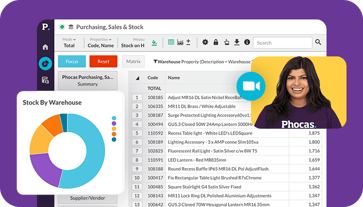
Find out how our platform gives you the visibility you need to get more done.
Get your demo today Analytics
  Financial Statements
  Budgets & Forecasts
  Rebates
  CRM
CRM  Sales Insights