You already have an analytics platform. Your data is connected, your team uses it daily and you're getting real value from it. But AI is everywhere and someone in your business is asking the question: do we still need this, or can we just use AI instead?
It's a fair question to raise. A recent Phocas survey found that 50% of customers are individually experimenting with general-purpose AI tools like Chat GPT and Claude. Naturally business people want to understand whether these tools can also do the work of analytics, reporting and financial planning. The short answer is not really.
Right now, there are about five ways distributors and manufacturers can access AI within analytics and planning workflows. While many sound similar, they are built differently and they are not like-for-like. Understanding these differences are important for you to make decisions about the future of your data strategy. Let's review what's on offer in the market and how each approach might fit within your business.
AI turbocharges the build vs. buy consideration
The build vs. buy debate has been part of enterprise software for decades. The core question has never changed: can you build something yourself, or is it smarter to buy software that's already built, supported and proven? AI has turbocharged the "build" side of the argument but it hasn't changed the underlying economics or what's at stake in the buy decision.
The CFO Shortlist framework states it well: "AI reduces the friction of building. It does not reduce the consequences of ownership."
AI tooling makes a prototyping even cheaper. But ownership is expensive especially if reliability, security and scale are important to you. And for existing customers of a platform like Phocas, the real trade-off isn't capability. It's whether switching or building software alongside delivers enough additional business value to justify the full cost of doing so.
That cost includes your team's time, the ongoing maintenance burden, the risk of inaccurate outputs and the opportunity cost of everything that doesn't get done while you're building, testing and debugging. Unlike a SaaS solution with predictable license fees, a clear roadmap and support, a custom build puts all of that on you.
What the market is saying
In addition to insights from our own customers' AI experiences, we reviewed industry reports to better understand the preference the preference for building AI solutions in house versus buying established platforms. According to the DSG State of AI in Distribution 2026 report, 93% of distributors plan to increase AI investment but only 16% have implemented beyond pilots. Just 4% say AI is central to their strategy. The primary barriers aren't budget or technology: they're skills gaps (33%) and change resistance (19%).
When we surveyed our customers the results matched the DSG research. 62% of distributors advised individuals in the business are experimenting with artificial intelligence and 8% are interested in AI but haven't moved on it yet. 4% of the distributors surveyed had defined use cases they want to address but are contemplating the best approach to implement.
Interest is high but activity is varied. Results, for most, are still limited. AI has the potential to be transformative, creating significant opportunities to accelerate business performance but realising that value requires consideration of the associated costs.
DSG's own recommendation is leverage existing software solutions and technology partners before evaluating new AI point solutions. It's not a conservative take — it's the conclusion the data supports.
When you map the options side by side; DIY builds, ERP-native AI, AI point solutions, general purpose BI tools and a purpose-built platform like Phocas there is a consistent pattern. The fastest path to stronger AI outcomes is the platform already running your business. The comparison below shows why.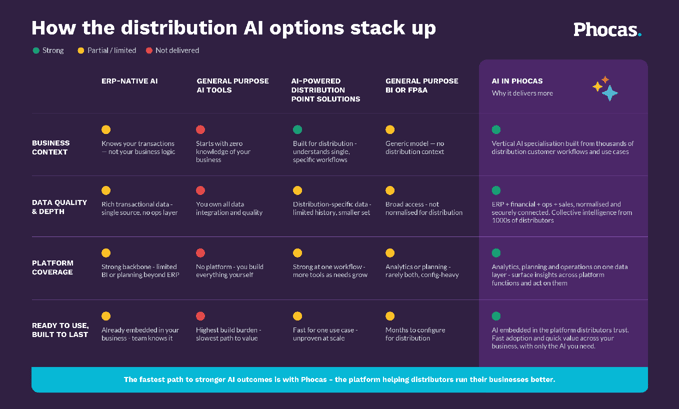
The hidden cost of building from scratch
If you're seriously weighing building custom software or connecting a general AI tool directly to your ERP, here are the trade-offs worth working through. This decision-making process matters and the wrong call has long consequences.
Total cost of ownership vs. time to value
Upfront costs for a custom build can look attractive. But the costs that matter include ongoing maintenance, iteration, security reviews and software development investment. The troubleshooting typically surfaces 12–24 months after launch, by which point the custom solution is embedded and replacing it is disruptive. Off-the-shelf software consistently wins on time-to-value. Off-the-shelf solutions almost always win on total cost of ownership too, making them the more cost-effective choice over the full lifecycle.
Data quality and business context
AI is only as good as what you put into it. Without validated ERP-connected data and shared business requirements, outputs are inconsistent.
DSG found that distributors with strong data infrastructure are 4.5x more confident about AI ROI than those with siloed data.
General purpose AI tools start with zero knowledge of your rebate structure or your margin definitions so outputs can look plausible while being wrong. These wrong answers are a data structure failure and need to be fixed with custom development taking significant and ongoing effort.
Platform coverage vs. point solution sprawl
AI platforms can genuinely speed up personal tasks. However, there's a meaningful difference between a tool that helps one person work faster and a system your whole business can rely on. The landscape of options is growing constantly: DIY builds, AI-native point solutions, shared prompts and self-built workflows. Each addition, however lightweight it seems, brings data inconsistency, maintenance overhead and inconsistency of results. When AI is built into the tools where work already happens, the efficiency gains land without the sprawl — and your team has one place to go for answers they can trust.
Ongoing support and talent durability
When the person who built the in-house integration leaves, the institutional knowledge goes with them. There's no roadmap, no support line and no one to call when the ERP schema changes. A software vendor spreads that investment in customer support and ongoing support across thousands of customers. An internal development team doesn't have that scalability. Vendor lock-in is a real concern when buying but key-person risk is just as real when you own the software built by one or two people.
Scalability and competitive advantage
The businesses pulling ahead on AI aren't the ones who moved fastest. They're the ones that are building on a clean data foundation with shared definitions, governed access, connected systems and then layered automation and AI capability built-in. That foundation is already in place for Phocas customers. The scalability is built in, and the competitive advantage compounds over time rather than requiring constant reinvestment to maintain.
Security and reliability
Security and reliability are critical in any AI platform because businesses need confidence that their data is protected, compliant and consistently accurate when making decisions. An established platform will combine AI innovation with enterprise-grade safeguards, including SOC 2 certified security controls, proven infrastructure and trusted governance practices that have been independently audited. Businesses need a stable, secure foundation for adopting AI without compromising data integrity.
The hybrid model: industry-specific AI working with your data
None of this means you shouldn't use AI tools. The best outcome for most distributors is a hybrid model which means industry-specific AI built into trusted business processes and systems augmenting what they already do rather than replacing the foundation.
NAW and MDM research makes a point that's easy to miss: most distributors are undervaluing the AI already embedded in their existing solutions. The rush to evaluate new software and point solutions is pulling attention away from functionality that's already connected to your data, already governed and already available.
The CFO Shortlist puts the picture clearly: "The most durable model in 2026 is not build or buy. It is structured systems augmented by flexible AI-native workflows."
That's exactly what approaches like MCP (Model Context Protocol) enable. This technology makes your trusted, validated business data accessible in AI tools and agents helping you optimize existing workflows and streamline business processes without rebuilding the foundation. You don't have to choose between Phocas and AI. You can have both, working together, on the data your team already relies on. For end users, that means a familiar user experience with AI capability layered in.
Before you build or switch, ask what your business is taking on
The AI moment is real. Evaluating your options is the right move and it's a healthy part of any digital transformation effort. But there's an important difference between exploring AI and replacing a working system with something untested.
The build vs. buy question isn't just about functionality or pricing. It's about whether your business goals are better served by a proven off-the-shelf solution with a supported roadmap or by the full weight of in-house software development, ongoing maintenance and custom development landing on your team.
For existing Phocas customers, the question isn't whether AI is valuable. It's whether the value of building software from scratch or moving to a point solution outweighs the compounding advantage of AI built into the platform your team already uses and trusts.
Inventory trends in wholesale distribution
Download now


Ashley Bass is a dynamic product and marketing professional who leads with passion, pragmatism, and a commitment to delivering customer and business value with a bit of fun and flair. She has deep experience across the product life cycle and has delivered on execution and strategy for a variety of software businesses in various stages of scale and growth over the last 15 years in the US and NZ.
Related blog posts



Browse by category
Find out how our platform gives you the visibility you need to get more done.
Get your demo today