The current state of AI in the distribution industry
The AI conversation in the distribution sector is loud. AI dominates tradeshow agendas, press headlines and LinkedIn feeds. Yet for most distributors, the reality at a branch level is still in its infancy.
The Distribution Strategy Group's State of AI in Distribution 2026 report states most (63%) distribution businesses are in early-stage experimentation with artificial intelligence. This is consistent with the conversations we are having with customers from HVAC to hardware supplies that are playing around with chatbots in customer support or robotics for inventory management. There are also some outliers who have programs in train but this is the exception. These big distribution players have intent but are uncertain about what to optimize first. They frequently advise they have underestimated how hard the doing is.
To carry out artificial intelligence well in a distribution business requires connected data and the ability to translate complex decision-making into tools your team will use. Doing it yourself such as stitching together standalone AI tools or asking your IT team to build something from scratch is high risk for distributors according to both the research and our industry tech know-how.
We think it’s important to advise, especially if you’re just starting out or in the planning phase, we don't think it’s a good idea to go it alone. The smarter path is to work with a tech partner who understands distribution and already has your data in their platform. Rely on them to automate the tasks that will help you the most such as demand forecasting or cross-selling based on customer behavior.
Why DIY AI is harder than it looks
It's tempting to think that signing up for a Claude Cowork subscription or purchasing a new AI technology distribution point solution will bring fast competitive advantage to your business. The tools are accessible and the demos are impressive but the application is more technical.
The Distribution Strategy Group's 2026 findings highlight execution is lacking. Distributors operate in one of the most fragmented data environments of any industry. We know this, because Phocas has been combining data from industry ERPs, supplier systems, CRM and warehouse systems for 25 years. These systems often run in parallel without a common foundation. When you try to layer AI across this data and systems without first addressing it, this is problematic.
Building AI on a broken data foundation produces unreliable outputs for distribution companies. Your sales, finance and operations team won't use an AI tool that gives them the wrong numbers so if you go down the generative AI DIY path, you start getting data problems. Usually to solve data problems, this is outsourced as not many distributors have this expertise in-house.
Beyond data, there is also an industry match. AI is most valuable if it integrates into how your people work. Mapping AI to real distribution tasks requires someone who knows how quotes get built, how inventory gets reviewed and how customer conversations turn into follow-up actions. Generic AI tools don't know any of that so need to be taught. And teaching them is expensive, time-consuming and technically demanding.
What distributors want from using AI
According to the State of AI in Distribution 2026 report, distributors want AI to solve narrow, practical and immediate problems. This finding we thought was interesting and lines up with our own AI product roadmap. Currently, distributors say they want specific improvements in how work gets done.
The most common use case demands are around reducing manual effort in everyday tasks such as with quoting . Most distributors will measure AI benefits by time savings and efficiency gains like did my reps get quotes out faster? Strong demand for simple, immediate value is the defining feature of the distribution AI market right now.
Consider this example for improving quoting using a distribution-focused AI tool in practice. A sales rep receives an email request for a quote on 33 line items. Currently the sales reps manually searches each SKU, checks pricing, confirms availability from warehouse operations and populates the quote form. With AI embedded in quoting, the system reads the request, pre-populates the quote with current pricing and stock levels. The rep reviews, adjusts and sends to the customer much faster.
This ai-powered operational efficiency is available today if the artificial intelligence is properly connected to your data and embedded in the systems your people are already using.
Using your current ecosystem for AI
Another important finding in the State of AI in Distribution 2026 report is the shift in how leading distributors are thinking about AI integration. Usage is moving away from standalone tools toward AI that is embedded directly in the platforms distributors already rely like the ERP, CRM, business intelligence and planning systems.
The report is explicit in advising distributors to look to their current technology partners to deliver AI before they go looking for new tools. This is undervalued and should be pursued, because embedded AI reduces integration complexity and leverages existing data relationships.
Take Phocas as an example, as we already sit at the intersection of your ERP, ecommerce, rebate and CRM data. Phocas consolidates sales history, inventory levels, customer behaviour and financial performance into a connected, trusted data platform. Adding AI capability to Phocas means building on a foundation that already understands your business in wholesale distribution and is not starting from scratch.
One of the most consistent barriers to AI success in distribution is low confidence in the underlying data. Phocas helps distributors build a clean and trusted data foundation that allows AI to work on reducing stockouts or streamlining order processing.
The message from the State of AI in Distribution 2026 is straightforward. Ensure you improve practical use cases in the first instance and consider your existing tools wherever possible to achieve efficiency gains with AI.
You don't need to build an AI strategy from scratch, rather look to your existing industry tech partners who have worked out how to connect your data, build reports and templates and embed AI so they can deliver immediate value.
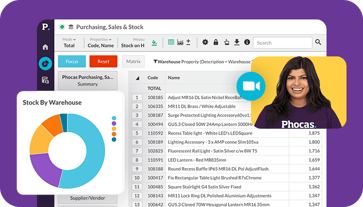
Inventory trends in wholesale distribution
Download now


Katrina is a professional writer with a decade of experience in business and tech. She explains how data and AI can work for distribution professionals and finance teams without all the tech jargon.
Related blog posts

Aktion Associates has been named FY26 North America Partner of the Year in the inaugural Phocas Partner Awards, following 90% year-over-year growth. A leading North American ERP and business technology partner to mid-market companies in architecture, engineering, construction, distribution and manufacturing, Aktion has worked with Phocas for six years to help customers see business performance more clearly and make more informed decisions.
Read more
Klipboard has been named the EMEA winner of the inaugural Phocas Partner Awards, recognizing the work its team has done to help distributors across EMEA become even more data-driven.
Read more
Kilimanjaro Consulting has been named the APAC winner of the inaugural Phocas Partner Awards. Kilimanjaro has grown customer value year-over-year, with 30% of existing customers extending their use of Phocas.
Read more
A recent Phocas survey found that half of the distribution respondents are testing general-purpose AI tools like ChatGPT and Claude on their own, outside of any business system. That's a reasonable thing to do but it is also where generic AI gets the numbers wrong for distributors in ways that are hard to know, because the answer looks exactly like a right one. It is important to know why a powerful generic AI tool can still be a wrong one and some of the important considerations of handing over your data to an AI engine.
Read moreBrowse by category
Find out how our platform gives you the visibility you need to get more done.
Get your demo today