How to motivate staff to increase productivity when working from home
In business, the saying “time saved is money earned” couldn't be more true. Yet businesses throw away thousands of dollars each day in wasted time. This happens at every level from management to staff. By applying a few motivational techniques to your business, you can increase productivity and profits - even when people are working from home.
Most companies have now set-up their workers from home and the question is - will they ever come back to the office? Last year people were concerned with having the right tech tools, ensuring Zoom was always on and whether the HR and operational processes were up-to-date. Now the focus has turned to keeping people motivated when working from home. Here are some basic tips:
Provide clear training and instruction
An employee who doesn’t know how to perform a certain task will procrastinate because they lack the confidence and skills to jump right in. These employees will stumble as they try to learn the process to complete the task and with no co-workers to ask questions they can often make mistakes that require fixing. All of these interfere with the time required to complete a task. Even when they know how to complete a task, if management’s instructions and intent are unclear, the employee may not produce the desired results.
Trust your people
Some managers may think remote workplaces as a risk to productivity, as it is not known if staff are doing the same volume or quality of work as what they would usually be doing in an office environment. By now, this view has probably been abandoned. However, if you are still having these issues it may indicate an absence of trust in team members and could have broader implications for your team's effectiveness. This is especially important when team members are remote, and leaders can demonstrate trust in the workplace by giving staff the time to complete their work, continuing to delegate important responsibilities and limit reporting on individual tasks.
Provide ongoing professional development
When people are working from home it is easy to forget about offering or encouraging people to complete professional development. Ensure that you suggest courses your team might like to do online and share what others in the team are doing to motivate and plant the seed for ongoing development and growth.
Profit sharing
Commissions are a common tactic to motivate the sales team to increase sales. Despite this, other members of your business such as support staff work equally as hard and do not see these kinds of benefits. The same method used to increase sales, the money motivator, can also be used to increase productivity. By offering profit sharing, employees begin to see the company as their company and increasing company profit becomes a personal endeavour for them. In addition, staff retention is likely to increase.
Use Phocas
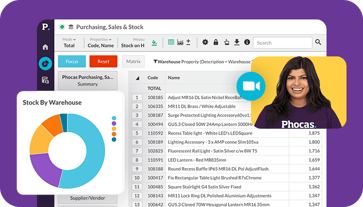
Phocas saves time and increases productivity by giving employees quick and easy access to business information. Instead of spending hours working with spreadsheets in an attempt to locate the information they need, an employee simply needs to access their Phocas dashboard. This makes it easier to isolate certain issues, such as sales trends within the company and determine where improvements can be made. Phocas is compatible with other software including Excel, SAP B1 and Microsoft Dynamics NAV and can compile and convert information into easy to read reports.
If you could increase productivity by enabling your staff to work hard and work smart from home, wouldn’t you do it? Applying these basic techniques to your remote workers and watch things change.


Empowering businesses with intuitive data analytics, driving informed decisions for growth and profitability. We make people feel good about data.
Related blog posts

Aktion Associates has been named FY26 North America Partner of the Year in the inaugural Phocas Partner Awards, following 90% year-over-year growth. A leading North American ERP and business technology partner to mid-market companies in architecture, engineering, construction, distribution and manufacturing, Aktion has worked with Phocas for six years to help customers see business performance more clearly and make more informed decisions.
Read more
Kilimanjaro Consulting has been named the APAC winner of the inaugural Phocas Partner Awards. Kilimanjaro has grown customer value year-over-year, with 30% of existing customers extending their use of Phocas.
Read more
If you've been paying attention to the data analytics space lately, you've probably noticed a new term emerging into conversations that used to be dominated by business intelligence (BI) and that’s decision intelligence (DI).
Read more
Food and nearly everything else that is bought and sold must travel from where it is produced to the buyer. Transportation costs are rising sharply. Oil prices have surged by approximately 45% and gas by 55% since late February, a direct consequence of the escalating conflict in the Middle East. Distributors and their supply chain managers have been up against inflation and rising prices since the pandemic and and to cope with continuing shocks like the Middle East crisis most have had to change their supply chain processes to manage a more volatile marketplace. Business intelligence (BI) helps distributors understand risk exposure and make confident decisions when the range of possible futures runs from bad to considerably worse.
Read moreBrowse by category
Find out how our platform gives you the visibility you need to get more done.
Get your demo today