Business leaders want to make decisions faster and with more efficiency. Without visible data that is accessible and organized, it’s nearly impossible to make well-informed decisions. Liked driving a car on a foggy road at night, you will have difficulty identifying the best route or avoiding potential obstacles on the road. However, with data visibility, you have the clarity to make good decisions at the right time, as well as the flexibility to respond to potential challenges.
Cloud technology makes data accessible
Cloud technology gives us the ability to store unlimited data over the internet rather than on a computer’s hard drive. This includes business documents, email, and contact management information, as well as the massive amount data your company generates daily. When your data is stored in the cloud, you have real-time access from anywhere using your computer, tablet, or smartphone. Mobile accessibility gives you the freedom to work on the go.
Consolidated view of performance
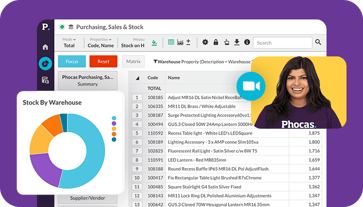
As businesses grow, they typically adopt a variety of business systems. Although these systems are important to manage the company on the whole, separate systems mean disparate data. Implementing a data analytics solution such as Phocas will integrate the data from your various silos and consolidate it into one source of the truth.
With a consolidated view, managers have complete transparency across all of your domains. They can keep an eye on the metrics that matter to them and monitor things such as inventory turns, revenue, profit, customers in decline, and more, with just a few clicks on the dashboard.
Understand 'why' something is happening
Data analytics can show you ‘why’ something is happening in your company. Let’s take customer loss as an example. Dealing with customer loss is a normal part of running a business. As such, many companies must focus on customer acquisition to replace lost customers. Even so, customer acquisition is far more costly than customer retention. Therefore, understanding why you are losing your customers to your competitors is critical to stopping the decline. This is the role of a data analytics solution.
The dashboard will allow your teams to question your data for insights into why your customers are leaving. Analytics can help you examine the performance of your products, product lines, sales reps, and customers by region, division, brand and channel and time period. This will reveal any patterns in the data to show you ‘why.’ Once you understand why something is happening, it’s easier to do something about it.