5 common business intelligence problems
When people aren't getting value from a business intelligence (BI) solution, it may seem like the software is causing more trouble than it is worth.However, the business intelligence problems are often not due to the user or to the software alone, but rather due to the mismatch between the two.By utilizing the support the software provider offers, or by choosing another solution, many businesses will start to see results almost instantly.
To be successful in the adoption of a BI solution and to reap the benefits the solution may offer your business, it is important to be aware of common pitfalls so that they can be avoided. This blog will outline five of the most common challenges businesses face when using BI, and how to overcome them.
Problem 1 - A lack of communication during the implementation process
Communication during the implementation process is essential to ensure the solution can solve the pain points your business is seeking to address. A lack of communication can result in a business having invested in a solution that cannot do what key users thought it could, leaving the solution largely unused.
To avoid this, it is important that communication between teams and with the provider occurs on an ongoing basis. The team leader needs to continuously consult with key stakeholders to ensure everyone is on the same page. As the buying and implementation processes are occurring, the team leader furthermore needs to keep the channels of communication with the solution provider open to ensure the solution meets the needs of the business.
Problem 2 - Lack of support from the BI provider
A big challenge for many new BI users is the lack of support from the software provider. A lack of support, in the best case, means your employees do not know all the solution has to offer and thus cannot get maximum value from it. In the worst case, they simply will not use it because it is not functioning correctly. Either way, your business is not seeing the ROI it could.
This challenge is one many businesses who have opted for low-cost BI tools face. While we are by no means suggesting you need to invest in the most expensive tool on the market, ensuring the solution you choose has sufficient support available to its customers is essential. At Phocas, we have a dedicated customer success team that will help you get the most out of our software. We also have an online training academy with tutorial videos, as well as an online user forum where users can share best practice advice and ask questions.
Problem 3 - Staff don’t want to adopt the solution
In some cases, the software implementation appears to have gone well, the project managers are satisfied the solution can do what was expected, and users have been given access, yet the solution is not being used. This is often seen when the BI solution does not have an intuitive interface or requires advanced training. While the IT department, and any others involved in the selection and implementation of the BI solution may feel the solution is easy to use, it is important to remember that staff in other departments may not have much technical experience and are often running short on extra time.
To promote user adoption, it is important that the solution in easy to use, requires minimal training, and it is made clear how the software can benefit each user. At Phocas, our customers report being able to use our BI solutions after as little as 15 minutes of basic training. Moreover, with easily accessible academy videos and an intuitive user interface, our customers find that including Phocas in their daily activities saves time almost immediately.
Problem 4 - The BI software provider does not understand your industry
When businesses are not seeing the results they were hoping for with their new BI solution, and the vendor seems unwilling or uncapable of helping their customers achieve the full potential of their solution, it is often because of an lack of understanding. When a manufacturing company invests in a BI solution designed for services bases businesses, problems are likely to occur. The solution may not have the appropriate possibilities for tracking products along the supply chain, measuring lost sales or building the right reports at the end of each month.
By choosing a BI solution that is built for, and where the vendor has many years’ experience with your industry, you ensure your business gets a maximum ROI. At Phocas we have worked with retailers, wholesale distributors and manufacturers all over the world. We know which questions you may not have thought of asking yet, while we retain the possibility to adapt to challenges specific to your business.
Problem 5 - The solution is not in the cloud
A final reason your business may not be getting the expected value from your BI solution, is because the solution is not in the cloud. If you have invested in or are planning to invest in a BI solution that is not accessible on mobile devices, you risk a lack of user adoption.
Solution
By allowing your employees to access the BI solution on the go, while waiting for a meeting to start or while on in the home office, you lower the barrier to use the solution. Phocas is accessible anywhere. An executive might quickly analyse some trends before stepping into a meeting, and a sales rep might get an overview over a customer’s historical buying data before a customer visit. One Phocas customer even uses Phocas with Amazon Alexa to allow him to analyze data while driving.


Empowering businesses with intuitive data analytics, driving informed decisions for growth and profitability. We make people feel good about data.
Related blog posts

Food and nearly everything else that is bought and sold must travel from where it is produced to the buyer. Transportation costs are rising sharply. Oil prices have surged by approximately 45% and gas by 55% since late February, a direct consequence of the escalating conflict in the Middle East. Distributors and their supply chain managers have been up against inflation and rising prices since the pandemic and and to cope with continuing shocks like the Middle East crisis most have had to change their supply chain processes to manage a more volatile marketplace. Business intelligence (BI) helps distributors understand risk exposure and make confident decisions when the range of possible futures runs from bad to considerably worse.
Read more
Inventory days formula is equivalent to the average number of days each item or SKU (stock keeping unit) is in the warehouse.
Read more
How can you maximize the business benefits from your enterprise resource planning (ERP) system? You get there by rethinking ERP reporting as a layered reporting system that turns ERP data into real-time insights, not just historical outputs. For years, enterprise resource planning platforms have been the backbone of manufacturing, distribution and retail because they capture orders, inventory, invoices and financial data in one place. Yet the price and effort of implementing ERP software has often led business people to question whether the company is getting the value they expected. It depends on how well people can access, analyze and act on the information inside the ERP system and related data sources.
Read more
Picture a football coach preparing for the big game. He watches game‑tape, studying player metrics, analyzing every play and using real‑time stats to inform strategy. That’s exactly how sales managers and sales leaders should approach their coaching program—with a data‑driven approach.
Read moreBrowse by category
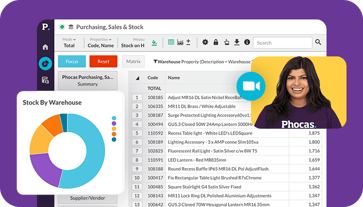
Find out how our platform gives you the visibility you need to get more done.
Get your demo today