Sales reps spend just 40% of their workweek selling, according to Salesforce's 2026 State of Sales report, which surveyed more than 4,000 sales professionals across 22 countries. The remainder is taken up by activities including research, planning, internal work and admin. That's an industry stat but it's also the problem we're fixing.
Reps don't avoid CRM because they don't care about pipeline discipline. They avoid it because typing notes into a desktop tool between meetings isn't how they work. So, notes don't get logged, the pipeline goes stale, and the sales forecast follows.
CRM software is widely deployed, but deployment doesn’t guarantee useful data. When updating the CRM is slow or disconnected from the rep’s workflow, missing and outdated information quickly limits its value. That challenge is worse for field sales teams in distribution and manufacturing. They often move directly from one customer site to the next, leaving little time to type detailed notes or update multiple CRM fields between visits. So data ends up scattered across personal notebooks, phone notes and a spreadsheet someone pulls together right before the pipeline review.
Two updates just went live in Phocas CRM that address this problem head-on.
AI Voice: 45 seconds, hands-free
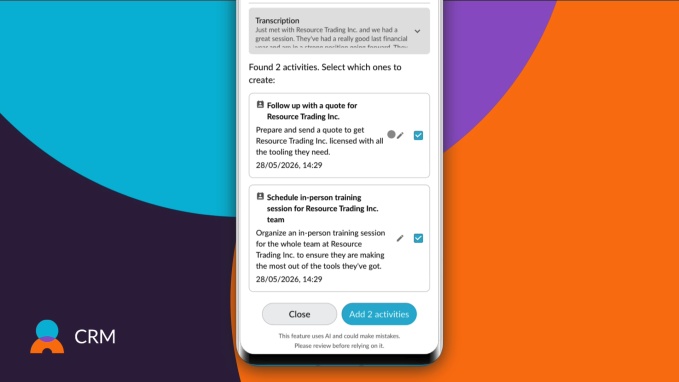
Reps finish a customer meeting. They tap record on their phone. They talk through what just happened, follow-ups, next steps, the way they'd tell a colleague.
Phocas CRM turns that recording into structured notes and creates the follow-up tasks automatically.
How it works: speech-to-text transcribes the audio, and generative AI extracts the actionable parts: what was discussed, what needs to happen next, when. No typing. No copying and pasting. No late-night admin.
It works because reps talk faster than they type. Recording right after a visit also helps them capture details while they're still fresh: the objections, the offhand comment about a competitor, and the context that gets lost when notes are written hours later.
Why it matters
One of the most persistent reasons CRM investments underperform is that reps don't log activity. When visits, decisions and next steps aren't captured consistently, the pipeline and forecasts built from that information become less dependable. AI Voice removes the biggest reason for that: it takes too long. If capturing a visit is faster than skipping it, the CRM finally gets filled in, and every downstream metric leaders care about (pipeline accuracy, forecast confidence, coaching visibility) starts working again.
Drag-and-drop pipeline: every deal, every stage, one view
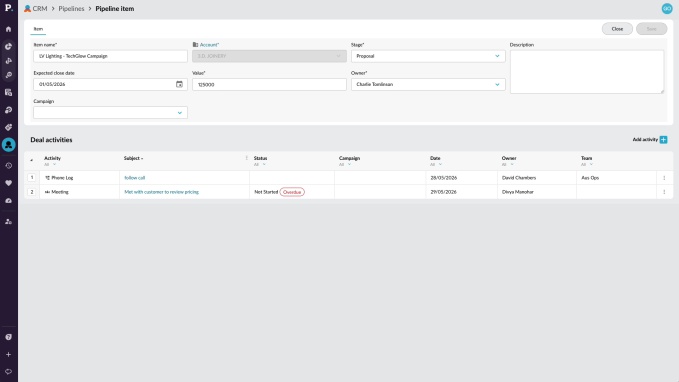
The new visual pipeline is the deal-management view that distributors have told us they need most to manage their sales pipeline. Every deal shown as a card. Every stage as a column. Drag a card from Qualified to Proposal in one motion: the pipeline updates in real time, the activity is logged automatically, and the deal history is kept intact.
Filter by rep, spot what's moving, what's stuck, and where the coaching moments are, all without exporting a spreadsheet.
Why it matters
Pipeline data is only trustworthy when it's current. And pipeline data is only current when updating it is a one-click job, not a separate "update the CRM" task at the end of the week. Drag-and-drop makes pipeline updates happen in the flow of selling, so what leaders see is what's actually true.
Built for how distributors and manufacturers sell
Many general-purpose CRMs are designed to accommodate a wide range of sales models. Distribution and manufacturing teams often need a more specific combination: mobile activity management together with the product, customer, order and margin data held in the ERP. Phocas CRM brings those elements into the same platform, so reps can move between account activity and underlying sales information without piecing the picture together manually.
What AI Voice and drag-and-drop pipeline mean for sales leaders and reps
For sales leaders, it means a pipeline you can trust walking into a Monday-morning review, without chasing reps for updates first. Coaching conversations that start from what actually happened that week instead of a spreadsheet stitched together on a Friday afternoon.
For reps, it means less admin after a visit, less risk of forgetting details between one stop and the next, and a CRM that fits into the day instead of adding to it.
Why CRM adoption is a bigger conversation in 2026
A few shifts are pushing CRM adoption back onto the agenda for sales leaders in distribution and manufacturing, beyond the two features covered here.
AI voice and generative AI. AI tools are now part of everyday work, not a feature bolted onto one app. Reps are used to that kind of help everywhere else, from voice assistants that transcribe a call to email tools that draft a reply, so they increasingly expect the same from a CRM: something that helps write things up and generates tasks to action, not simply to store information.
Mobile-first design. It's gone from a differentiator to a baseline expectation for reps who spend most of the week in the field. Reps using mobile CRM tools report meaningfully higher quota attainment than those without it, according to CRM.org's research.
ERP-connected CRM. It's pulling away from generalist CRM because distribution and manufacturing sales run on product-level detail and repeat-buying relationships. Connecting the CRM directly to that data removes the manual double-entry that erodes trust and adoption. For manufacturers with longer, cross-functional buying cycles, the same connection keeps institutional knowledge about an account in the system instead of only in a rep's head.
Data quality. It's still the industry's biggest unresolved problem. Even with modern tools, Salesforce's research shows sales reps spend more than half their week on non-selling work, much of it manual data entry, which is exactly what AI Voice and drag-and-drop pipeline are built to fix.
Ready to see Phocas CRM built around how your sales team works? Explore Phocas CRM or book a demo to see AI Voice and the new pipeline view in action.
Smarter selling starts with segmentation
Download now


Lindsay is an experienced writer with a passion for translating complex content into plain language. Specializing in the software industry, she explains the importance of data access and analysis for all businesspeople, not just the data experts.
Related blog posts




Find out how our platform gives you the visibility you need to get more done.
Get your demo today