Syncing your distribution CRM and ERP for accurate revenue attribution and ROI reporting
If you work as a sales leader in distribution, a deal is usually counted by finance when the invoice goes out or the payment is received. Yet, if you use a generic CRM system, the sales win is often recorded as soon as the rep gets off the call with the new order. The CRM shows the original deal value. The ERP holds the details of what actually happened. For a distribution sales leader, that gap makes it harder to judge performance. You can see what the team has won, but you still need another report to find out what was invoiced, what remains outstanding and how much margin the sale generated.
Connecting a CRM and ERP data brings those records together. It helps you trace sales activity to actual revenue, understand profitability and give customers informed answers about their orders. It also provides the sales and cost data needed for ROI reporting, alongside campaign tracking and investment costs. This is why a CRM purpose-built for distribution, that connects seamlessly to a distributor's ERP, needs to be a core capability in the system you chose for your sales team.
What happens when the ERP and CRM don't sync
Most CRMs, including Salesforce, HubSpot and Pipedrive were built for software and services sales rather than products . These CRMs track a deal through to 'closed won' , but don't typically have an automatic sync or built-in connection to ERPs. When distribution businesses adopt these CRMs they usually need to retrofit a way to transfer the sale details like inventory quantity and price for each deal.
One primary issue is when distribution teams need to generate manual fixes to match the CRM to the ERP data. Every time sales data is manually re-keyed between the CRM and ERP there are several issues that arise. Often revenue attribution is compromised, there are errors such as missed line items or quantities that do not match what the ERP fulfilled, and delays between a sale and updates to the system of record can leave the CRM out of date, particularly when a deal closes on one day and the product is delivered on another.
Another major issue that can surface is in revenue figures. Most CRMs track deal value but not the true profit margin after freight, discounts and returns, which can cause CRM revenue figures to vary from the financial results reported in the ERP. When a sales leader uses a CRM with only the deal value figures they are likely to have a skewed view of which reps or campaigns are driving profitable revenue. The ability to see the true sales numbers and quickly analyze profit margin is key to staying ahead of any issues before the quarter ends.
Attribution, ROI, margin, order visibility in the same system
When your CRM activity and your ERP's order, shipment and inventory data share a platform, four things change for a distributor's sales and ops teams.
-
Revenue attribution becomes a more straightforward calculation because the account, the activity and the order all coincide with the relevant customer and sales rep. The revenue can be easily traced back to the deal, the campaign and the person who closed it.
-
See how much true margin each sales generates. Gross profit shows what remains after the associated cost of goods sold. Connecting sales and product-cost data helps you compare profitability by account, product or rep using a consistent definition agreed with finance. For ROI reporting, adding the cost of activity being evaluated is key. One useful measure is gross-profit-based-campaign ROI:
Campaign ROI = (attributed gross profit - campaign cost) / campaign cost x100
If a campaign costs $3,000 and is credited with $9,000 in gross profit, its ROI on that basis is 200%. The calculation requires campaign cost data and and attribution mode as well as ERP sales and costs. -
Reps can easily manage their pipeline through each stage and check stock availability using the same inventory data as the warehouse. Sales leaders can then see what's likely to close, what has already sold, and how much margin those sales generated.
Picture a distributor selling industrial fasteners through a regional sales team, Without an ERP connection, reps track opportunities in the CRM while orders, invoices and product costs sit in the ERP. A sales leader can see what reps expect to close, but must reconcile the two systems to understand what was actually sold and how much gross margin it generated .
-
Measuring sales performance using actual revenue and margin is easy because you can use actual sales and cost data. A closed deal doesn't always tell you what the business ultimately earns. Back-orders, rebates, and freight adjustments can change the final results. A rep closes a $40,000 deal in the CRM but has no connection to the ERP. The order gets placed and fulfilled in the ERP over the following two weeks, with a partial back-order and a negotiated freight adjustment. The sales reps makes a note of those adjustments to update the CRM. At quarter-end, the sales leader pulls a revenue-by-rep report from the CRM, which still shows the full $40,000 against the original close date, with no visibility into adjustments until the sales rep brings it up at a meeting and says he hasn't had time to update the CRM.
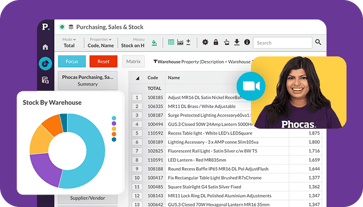
Phocas CRM is a module inside the Phocas platform where a distributor's sales, inventory, purchasing and finance data is also managed. All of these databases receive validated and synced updates from the ERP so the CRM can access all of this information.
The Phocas CRM has an ongoing connection to the ERP so your order, shipment and inventory data stays current and is refreshed every time a sales reps logs in each morning.
As CRM and Analytics sit on the same platform, you can open an account record from inside Analytics, or jump from a CRM account into the sales history and inventory position for that customer.
Reps can close the same deal and the order, while shipment and pricing adjustments flow through from the ERP into the same platform the Phocas CRM activity lives in. At quarter-end, sales leaders looks at actual shipped revenue and margin by rep, tied back to the original deal and account and the amount matches the finance reconciliation.
Salesforce, HubSpot and Pipedrive are strong at managing the sales relationship. None of them were built with native connections into distribution ERPs. To get order, shipment or inventory data into those tools, you typically need a separate integration platform, custom field mapping and ongoing maintenance every time your ERP changes a data field.
Phocas brings CRM and Analytics together around an existing ERP data foundation. That gives distributors a way to connect customer activity with transaction reporting within one platform. The connection still needs the right data mapping, refresh schedule and reporting definitions.
Frequently asked questions
The State of Sales in Distribution 2026
Download now


Empowering businesses with intuitive data analytics, driving informed decisions for growth and profitability. We make people feel good about data.
Related blog posts

Everyone working in distribution needs access to CRM for different purposes. A rep might manage customers across several branches and the regional manager is overseeing multiple states and reps. Finance partners often need visibility into major opportunities or want to check the terms of a sale but wouldn't edit transactions.
Read more
One in five distributors say their most pressing sales problem is reps not knowing which accounts to prioritize, according to Phocas' State of Sales in Distribution report. Guided selling takes over the digging, telling each rep who to call, why and what to say. Working out where to focus means checking who's stopped ordering, which product lines have slipped and where there's room to sell more. Reps can do that by hand, but it takes hours across different reports. Guided selling in a CRM built for distributors brings those answers to them, ranked by revenue impact, with every next step tracked.
Read more
Aktion Associates has been named FY26 North America Partner of the Year in the inaugural Phocas Partner Awards, following 90% year-over-year growth. A leading North American ERP and business technology partner to mid-market companies in architecture, engineering, construction, distribution and manufacturing, Aktion has worked with Phocas for six years to help customers see business performance more clearly and make more informed decisions.
Read moreBrowse by category
Find out how our platform gives you the visibility you need to get more done.
Get your demo today