Business intelligence vs Decision Intelligence. What’s the difference?
If you've been paying attention to the data analytics space lately, you've probably noticed a new term emerging into conversations that used to be dominated by business intelligence (BI) and that’s decision intelligence (DI).
The two sound similar and both involve data. Both help distributors and manufacturers run better businesses but they're not the same thing. Understanding the difference matters if you're thinking about how your business uses data today and where you want it to go.
This blog breaks down what each approach does, where they overlap and how decision intelligence builds on the foundation that business intelligence has spent decades establishing. One isn't better than the other as they solve different problems but for many business people, the natural next step from BI is to DI.
The core disciplines of business intelligence includes descriptive analytics that focuses on summarizing and interpreting historical business data to provide visibility into performance. This includes analyzing metrics such as last month’s sales, current stock levels and year-to-date gross margin to understand how the business is tracking.
Data aggregation also plays a key role by combining information from multiple systems and sources into a single, consolidated view. BI also includes KPI and metric tracking so distributors can monitor performance against business objectives.
Diagnostic analytics identifies the reasons behind business outcomes and performance changes. By drilling into trends, anomalies or revenue declines, businesses can uncover the root causes of issues and better understand the factors influencing results. Historical data review supports this process by revealing patterns and trends over time, helping all teams make more informed operational and strategic decisions.
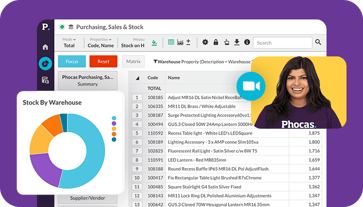
When using a tool like Phocas, BI gives everyone in your business access to the same numbers. It empowers everyone in the business to look at their own dashboards and drill into the detail. It is powerful and helps distributors make fast confident decisions about inventory and demand planning.
BI provides the insight into what happened, but you must decide what to do next.
What is decision intelligence?
Decision intelligence is what happens when BI is taken further to advise people what to do with the insight.
According to Gartner, decision intelligence is a practical discipline that improves decision-making processes by explicitly understanding and engineering how decisions are made, and then using intelligence such as data, analytics and AI to improve them. It takes the output of BI (insight) and turns it into the input for action (a recommendation).
The key technical layer that makes this possible is machine learning and artificial intelligence. Where BI is built on descriptive analytics and historical data, a decision intelligence platform adds predictive analytics to anticipating future outcomes. DI creates predictive models to estimate future demand and forecast outcomes that support planning and decision-making. These capabilities are powered by AI models and predictive modelling techniques that identify patterns and relationships within large datasets that may not be immediately visible to humans.
The key differences between BI and DI
The table below captures the core distinctions on the same evolution of how business people use data.
| Business Intelligence | Decision Intelligence | |
|---|---|---|
|
Core need
Business Intelligence
What is happening in the business?
Decision Intelligence
What should I do next?
|
What is happening in the business? | What should I do next? |
|
Analytics type
Business Intelligence
Descriptive, diagnostic
Decision Intelligence
Predictive, prescriptive
|
Descriptive, diagnostic | Predictive, prescriptive |
|
Primary output
Business Intelligence
Dashboards, reports, metrics, alerts
Decision Intelligence
Recommendations and actions
|
Dashboards, reports, metrics, alerts | Recommendations and actions |
|
Role of AI
Business Intelligence
Minimal
Decision Intelligence
AI models all predictions
|
Minimal | AI models all predictions |
|
Human interaction
Business Intelligence
Required to act on insights
Decision Intelligence
Supported by AI recommendations
|
Required to act on insights | Supported by AI recommendations |
The distinction between the tools is less about what's more sophisticated rather it's about your current business needs. If your team requires stronger visibility of sales and inventory, BI solves that. If your people need guidance on how to act on what the data is telling them, DI takes you there.
We like to think BI gives you the dashboard of performance and DI is the system that tells you when to adjust course.
Decision intelligence builds on BI rather than replacing it. You still need dashboards, data visualization, live KPIs and clean data analytics but DI adds the predictive layer to your current trajectory and patterns in your historical data.
This matters for wholesalers tracking thousands of SKUs, balancing supply chain variables and managing margins across product lines.
Three developments have made this evolution possible right now and that is because data infrastructure has matured. Most mid-market businesses have an ERP and at least some form of BI. The raw data is there so it just needs the next layer on top. Machine learning has also become accessible and is embedded directly into business software. Business conditions have accelerated requiring fast results and information.
Where to from here
Business intelligence and decision intelligence work hand in hand. The tools are sequential helping your team get from visibility to action and then from insight to recommendation.
If you're still building your BI foundation, that's the right place to start. Get your data clean, connected and accessible to everyone who needs it. Make dashboards and live KPIs part of how your business operates day to day. Build the habit of data-driven decisions. When that's working well and your team trusts the data and uses it to make decisions then you're ready for the next step. That's where decision intelligence comes in by adding the predictive layer that turns insight into a recommended action.
Inventory trends in wholesale distribution
Download now


Katrina is a professional writer with a decade of experience in business and tech. She explains how data and AI can work for distribution professionals and finance teams without all the tech jargon.
Related blog posts

Everyone working in distribution needs access to CRM for different purposes. A rep might manage customers across several branches and the regional manager is overseeing multiple states and reps. Finance partners often need visibility into major opportunities or want to check the terms of a sale but wouldn't edit transactions.
Read more
One in five distributors say their most pressing sales problem is reps not knowing which accounts to prioritize, according to Phocas' State of Sales in Distribution report. Guided selling takes over the digging, telling each rep who to call, why and what to say. Working out where to focus means checking who's stopped ordering, which product lines have slipped and where there's room to sell more. Reps can do that by hand, but it takes hours across different reports. Guided selling in a CRM built for distributors brings those answers to them, ranked by revenue impact, with every next step tracked.
Read more
Phocas is launching Tomorrow's Distributor, a new interactive learning series designed to help sales and finance professionals tackle everyday business challenges, make better use of their data and prepare for the future of distribution. We know the distribution industry is constantly changing. This year consolidation has proliferated, especially in America, where merger and acquisition transactions are up 7.7% year over year according to AXIA data. These new, larger companies create complex working environments that require systems that can ingest data from many systems into one platform for multi-entity reporting and consolidation. At the same time, 49% of distributors are using AI for sales but with limited impact according to our new State of Sales in Distribution Report. As Phocas works with distributors every day, we decided to respond to these changes by offering a free program to address some of these data and tech challenges featuring Phocas experts and customers.
Read more
Aktion Associates has been named FY26 North America Partner of the Year in the inaugural Phocas Partner Awards, following 90% year-over-year growth. A leading North American ERP and business technology partner to mid-market companies in architecture, engineering, construction, distribution and manufacturing, Aktion has worked with Phocas for six years to help customers see business performance more clearly and make more informed decisions.
Read moreBrowse by category
Find out how our platform gives you the visibility you need to get more done.
Get your demo today